The United States Consumer Is in the Driver's Seat
If you want the simplest way to frame Match Merge 2 right now, it is this: the genre is being built globally, but the money signal still runs through the United States.
Over the last 24 months, Match Merge 2 generated about $738 million in United States iOS revenue and about $1.71 billion worldwide. That means the United States alone accounted for roughly 43% of worldwide iOS revenue in the genre. Match Merge 2 is still smaller than Match 3 on this cut of the data, but it is no longer trivial relative to it: Match Merge 2 equaled about 22% of United States Match 3 iOS revenue and about 26% of worldwide Match 3 iOS revenue over the same window.
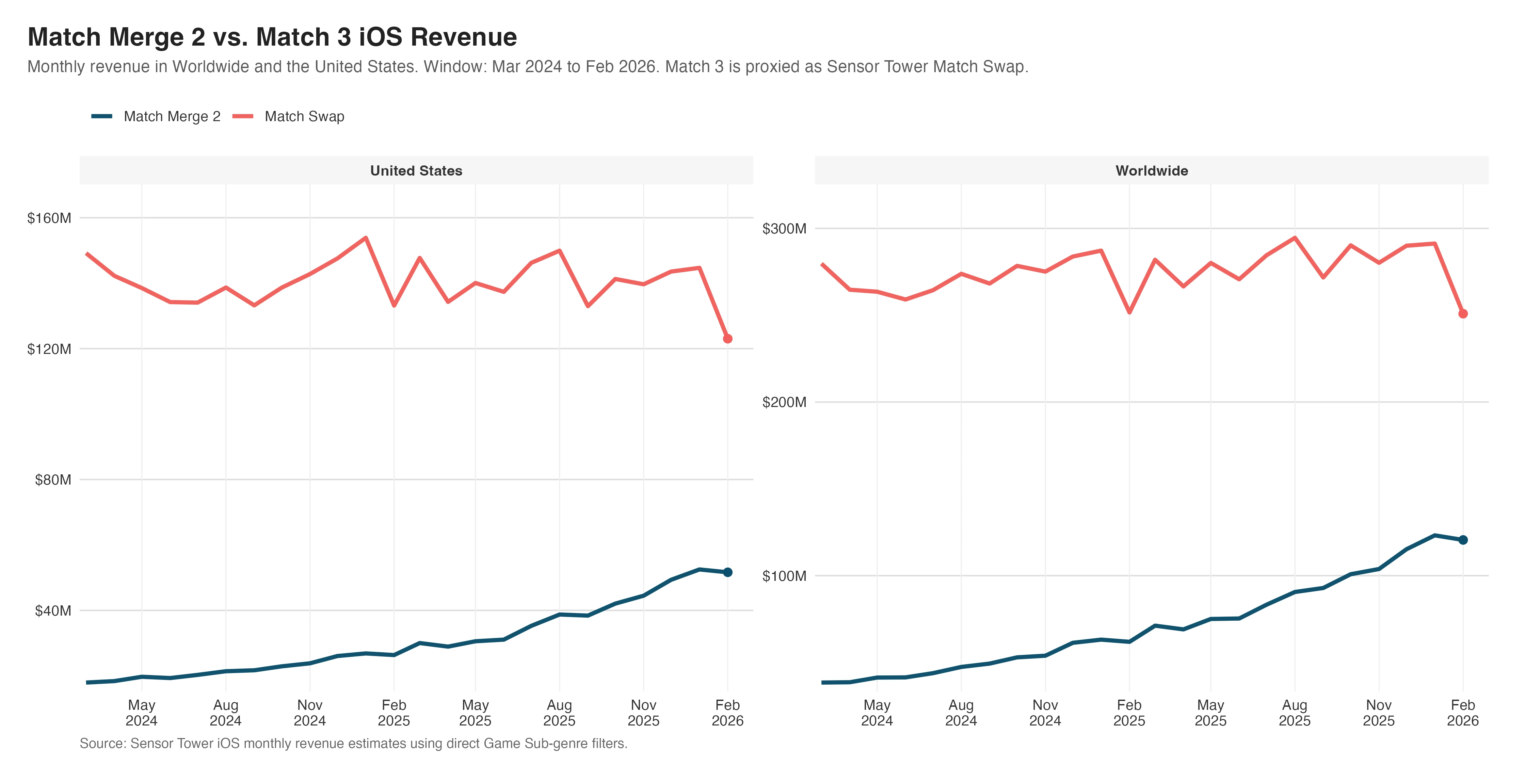
That is why I think the United States consumer is in the driver's seat. A single country contributing that much of global genre revenue ends up exerting outsized influence over what kinds of content, pricing, pacing, and live-ops structures get rewarded. The supply base may be international, but the commercial feedback loop is still heavily American.
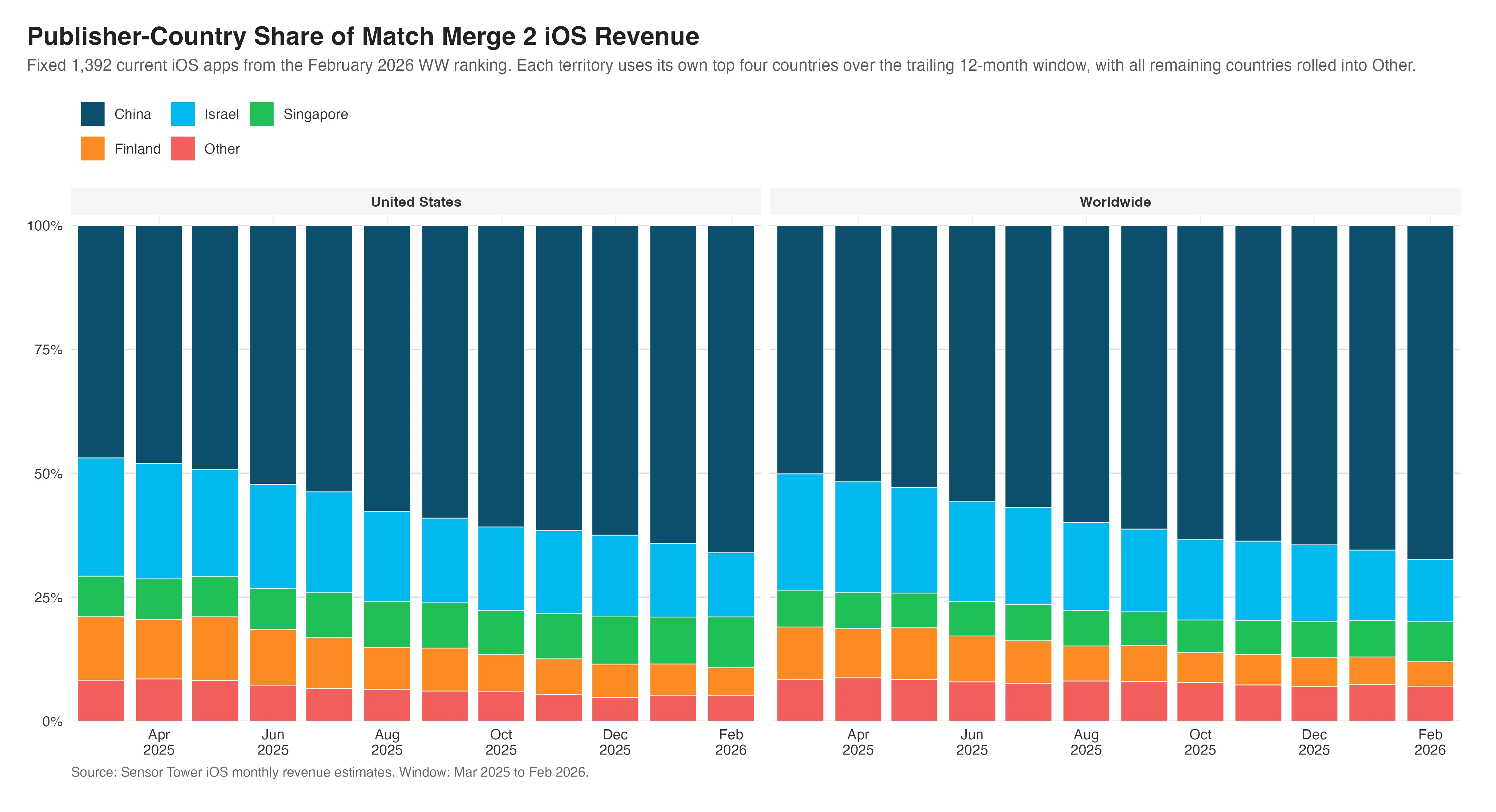
What is striking is that the firms capturing that revenue are mostly not American. Over the last 12 complete months in this fixed iOS cohort, China captured about 58% of United States Match Merge 2 iOS revenue, Israel about 18%, Singapore about 9%, and Finland about 9%. By the latest month in the cut, China alone represented about 66% of United States revenue and about 67% of worldwide revenue. So the genre's demand center is the United States, but much of the supply-side execution is coming from overseas publisher bases.
The pipeline data points in the same direction. On the known-region portion of the last 12 months of releases in the current Match Merge 2 iOS cohort, Asia accounted for 70 new titles and Europe accounted for 31. The Americas contributed 4 and the Middle East contributed 4. In share terms, Asia represented 62.5% of the tracked known-region pipeline, while Europe represented 27.7%.
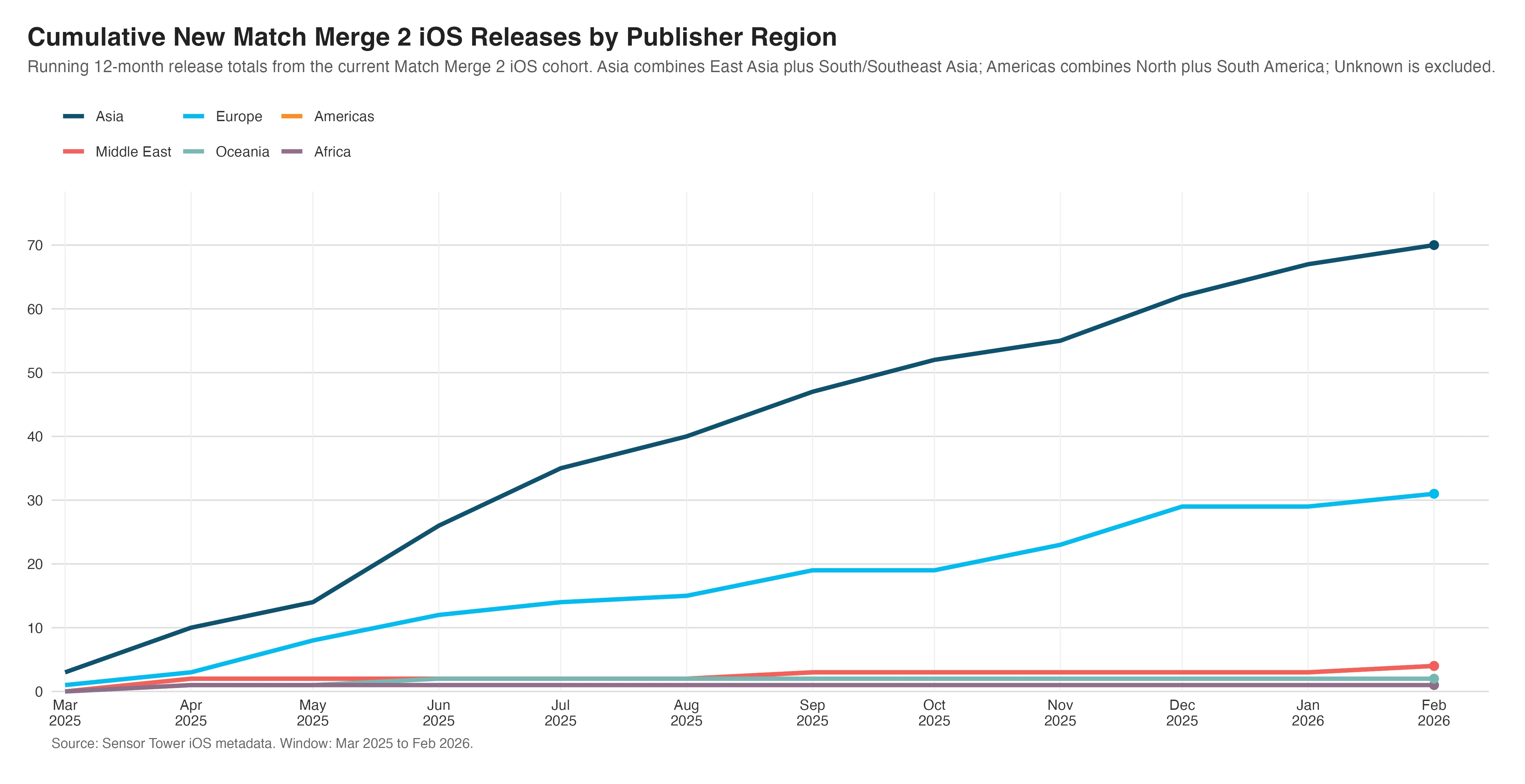
Put differently: the United States wallet is setting the prize, while Asia is doing most of the incremental building.
That is an important market structure. It suggests the next wave of Match Merge 2 competition is less about whether the genre has proven product-market fit and more about which publisher ecosystems can best translate global production into products that monetize with the United States consumer. This is an iOS-only cut, Match 3 is proxied here with Sensor Tower's Match Swap subgenre, the publisher-country chart is built from the current cohort rather than a historical point-in-time cohort, and the grouped release chart excludes titles whose publisher region is unknown. Even with those caveats, the directional story is hard to miss: global supply, American demand center.