The One Model Every Live Ops Manager Needs to Know
Open Monopoly Go and count. Eight pop-ups stand between you and the board. Open any social casino game and it is worse. Everyone in the building has an opinion on whether that is too many. Almost nobody has a model.
Each interstitial is a cost-benefit decision, and the right number of them is whatever maximizes net present game LTV. Not the number that feels polite, and not the number the art director can stomach. That sounds obvious until you notice that most teams pick the count by argument and then never test it.
The Model
Treat the boot sequence as an ordered list of \(n\) interstitials. Each offer \(i\) has three properties:
- \(p_i\), the probability it converts when it has the player's full attention
- \(m_i\), the margin per conversion: price, net of the currency handed over, the purchases it cannibalizes, and the platform fee
- a share of \(C(n)\), the cumulative retention cost of sitting through \(n\) pop-ups, in LTV units
Then one assumption. Attention dwindles with position:
\[a_1 = 1 > a_2 > a_3 > \dots > a_n\]
Nothing guarantees that conversion falls with each additional pop-up on its own. It falls because attention does. The third screen a player closes gets a fraction of the look the first one got, whatever is on it. Writing \({(k)}\) for the offer placed in slot \(k\), the value of the whole sequence is:
\[V(n) = \sum_{k=1}^{n} a_k \cdot p_{(k)} \cdot m_{(k)} - C(n)\]
Two questions fall out of this, and they are the only two questions a live ops manager needs to ask.
How many? Add pop-up \(n+1\) as long as it earns more than it costs:
\[a_{n+1} \cdot p_{(n+1)} \cdot m_{(n+1)} \ge C(n+1) - C(n)\]
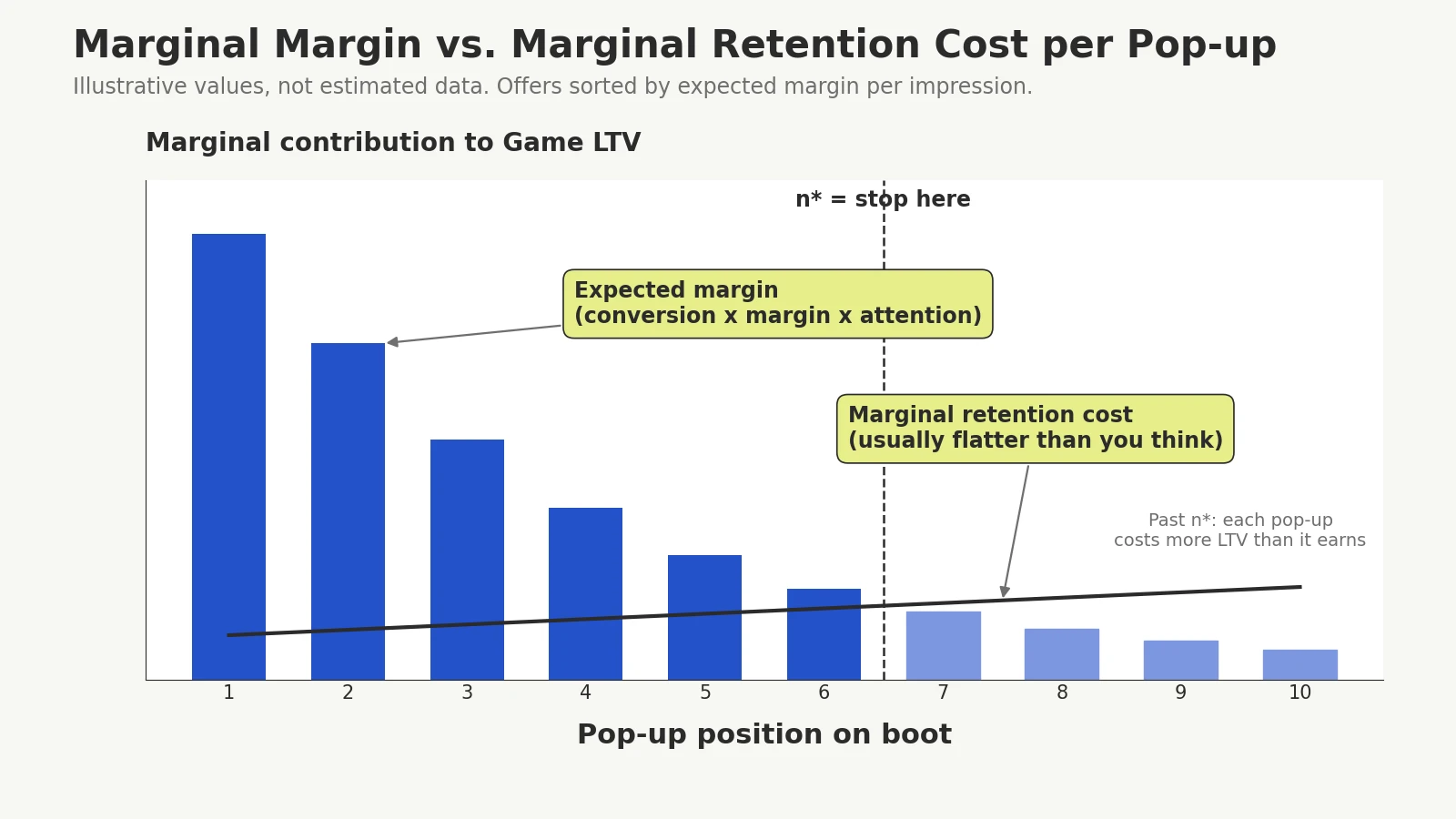
The left side is the marginal expected margin of one more screen. It falls with \(n\) because attention decays. The right side is the marginal retention cost, which is flat or rising. The two lines cross, and the crossing is \(n^*\). It is a different number for every game, and that is the point. Eight is not a rule. Eight is Scopely's crossing.
In what order? Because \(a_k\) is decreasing, the sum is largest when the offers with the highest \(p_i m_i\) sit in the earliest slots. Give the best expected margin per impression the most attention. "Put the likeliest conversion first" is the special case where margins are similar across offers. When a low-conversion offer carries a much fatter margin, it earns an earlier slot than its conversion rate suggests.
The Retention Cost Is Smaller Than You Think
I have watched a lot of teams run intrusive ad and interstitial tests, and the read is the same every time. Retention barely moves. Players are inelastic to boot friction in a way that offends product sensibilities. In model terms, the \(C(n)\) line sits low, so \(n^*\) sits well to the right of where instinct puts it. Monopoly Go's eight is not an accident or a lapse in taste. It is evidence.
What Product Managers Miss
Test the shape of the curve, not the next increment. The standard experiment is three pop-ups against four, and the standard result is noise. Run ten against a hundred instead. An extreme treatment tells you whether the LTV response curve is tall or flat before you spend a quarter optimizing a system that might not matter. This is the surface-area argument from the number one game experimentation mistake: if the realized treatment is small, a flat read says nothing about the system.
Put the free claim at the end of the chain. Today the daily free-currency claim lives in the store, where it competes with things you would rather the player looked at. Move it to slot \(n+1\). Players now tap through toward a reward they know is coming instead of mashing close, which raises every \(a_k\) in the sequence. The currency was already being given away, so the incremental cost is zero. The claim's own slot has \(p = 1\) and a negative margin, which is exactly why it goes last: its job is to lift the attention of everything ahead of it. A wall of ads becomes a daily ritual with a destination.
This is the one model because it is not about pop-ups. The same inequality prices every unit of friction a live ops manager controls: onboarding steps, store tabs, push cadence, ad placements. Marginal margin against marginal retention, ordered by expected value per unit of attention. Everything else is tuning.