The Economics of Merge-2 Games
Merge games represent a fundamentally different economic paradigm from match-3. Read Deconstructor of Fun's Finding Genre Success: the Case of Gossip Harbor. It fundamentally flips the casual economic equation upside down.
That became harder to ignore earlier in 2026, when Gossip Harbor outgrossed Candy Crush Saga.
In a match-3 economy, a useful approximation is:
\[\text{revenue} = [(\text{levels played} \cdot \text{expected fail screens per level played}) \cdot \text{p of converting after fail screen}] \cdot \text{price per conversion}\]
Revenue grows when players play more levels, see more fail screens, convert at a higher rate after failure, or spend more each time they convert.
Merge games are a radical departure with no core fail states. They replace fail states with an energy-based stop state, where players stop when energy or a production bottleneck impedes them. It ends up looking a lot like social casino, where energy functions as coins while also gating gameplay.
The genre compresses time with multipliers and higher-level drops, and introduces much more price variability through energy refills, cooldown skips, direct item purchases, and occasional board-space relief. Order cost and production are the right place to start because geometric growth is a constraining factor of "merging two." The genre brilliantly manages costs and production, creating deep economic loops in item management. Once that queue slows down, everything else slows down with it: coins, story progress, feature unlocks, and generator progression.
Meta Progress
A useful literal way to write the first step is:
\[\text{coins earned on day } t = \text{orders completed on day } t \cdot \text{average coins per order on day } t\]
\[\text{meta progress on day } t = \frac{\text{coins earned on day } t}{\text{coins required for the next meta step on day } t}\]
This keeps two things separate: 1) reward flow from orders and 2) meta cost. Merge games can slow progress by lowering reward flow, raising mission coin cost requirements, or doing both.
Exponential Demand
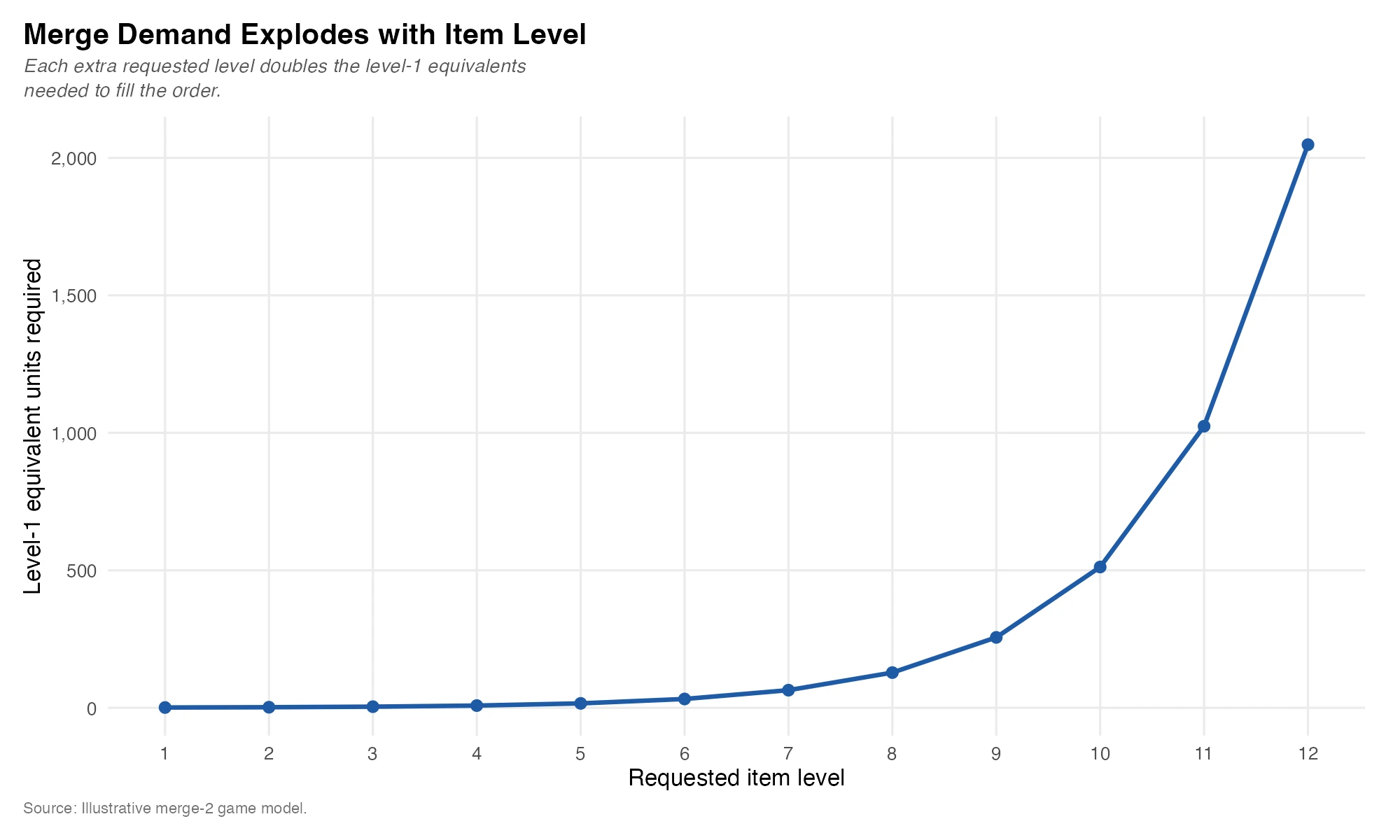
The game functions by merging two of the exact same item to create a new item at +1 higher level. Orders are collections of particular objects, which are satisfied by spending an energy unit to generate a single board object. This means we can express all orders as the number of level-1 copies required to fulfill an order.
\[\text{level-1 equivalent items for order item of level } L = \text{distinct items requested} \cdot 2^{L - 1}\]
Level-1 equivalent means the number of base items the player would have needed if they had to build the requested item from scratch. If an order asks for two Level 8 items, that is \(2\cdot 2^{7}=256\) level-1 items of demand.
For a whole generator, add up the level-1 equivalent demand of every requested item in the active order queue that comes from that same generator.
\[\text{level-1 equivalent demand on generator in order queue} = \sum_{\text{requested order items from generator}} \text{level-1 equivalent number of order items}\]
So if the queue asks for two bakery items and one Orange Tree item, you do not average them together. You total the bakery demand on the bakery generator, total the Orange Tree demand on the Orange Tree generator, and then compare each generator's own demand against its own supply. These are the valuable constraints and levers in the merge economy.
Increasing a requested item's level raises demand geometrically. If a designer bumps a requested item from Level 10 to Level 11, that is not a small adjustment. It doubles base-unit demand.
The genre's core gameplay system is an exponential cost curve inside order requests. To manage this, the genre introduced multipliers, or an increase in the level of an item generated.
The Multiplier
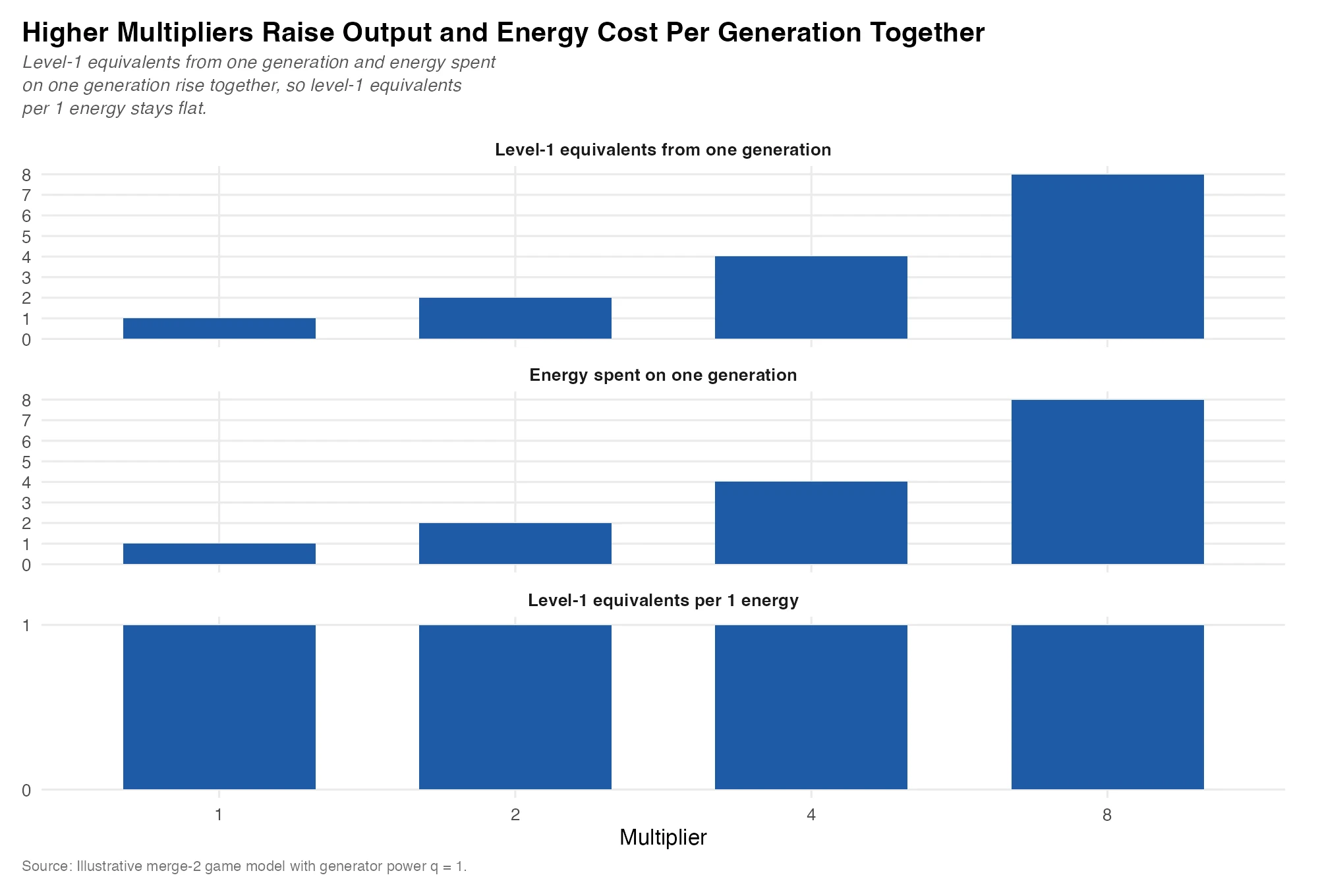
There are two separate objects to look at: level-1 equivalents from one generation, and level-1 equivalents per energy spent.
Level-1 equivalents means the number of base items one generation is economically worth after accounting for the higher levels it may skip to.
At multiplier \(\mu\):
\[\text{energy spent on generation at multiplier } \mu = \mu\cdot \text{1x energy spend}\]
\[\text{level-1 equivalents from generation at multiplier } \mu = \mu\cdot \text{level-1 equivalents from generation at 1x}\]
\[\text{level-1 equivalents per energy at multiplier } \mu = \frac{\mu\cdot \text{level-1 equivalents from one generation at 1x}}{\mu\cdot \text{energy spent on one generation at 1x}}\]
And for any fixed energy budget:
\[\text{generations available from a generator} = \frac{\text{energy budget}}{\mu \cdot \text{energy spent on one generation at 1x}}\]
Under clean linear scaling, mean energy efficiency is unchanged; what changes is the number of taps required to reach the order item level. A \(4x\) generation can hand the player what is effectively a much higher-level item, but that higher-level object simply embeds the low-level outputs and merges that would have been required under \(1x\) play.
Higher multiplier means:
- fewer generations
- fewer spawned objects (thus fewer merges)
- less board clutter (thus better board efficiency)
- faster burn of the player's energy balance
That last part draws the genre closer to social casino. It makes the active session more expensive in real time, effectively increasing the cost per hour, but with the benefit of increased acceleration. And just like slots, it lets players choose variance. Because the level and item generated from a generator come from a drop table, hitting an \(8x\) multiplier on a rarer generated item is a more significant boost in terms of forgone taps.
If the player has some current energy balance and is using generators at a steady pace, then expected time until the player hits the stop state is:
\[\text{minutes until 0 energy balance} = \frac{\text{current energy balance}}{\text{generations per minute} \cdot (\mu\ \cdot \text{1x generation energy cost})}\]
The expected value per energy unit may not change, but the player's bankroll gets consumed faster per minute of play.
Energy obviously has an income side too. For the purposes of this model, it's simple: energy regenerates over time until it hits the maximum stored balance and then gets spent back into production. Events, inbox gifts, and side rewards create a much richer energy-income system in practice, but I don't dive into that here.
Cooldown Chains
Not every order is primarily energy-gated; some are wait-gated.
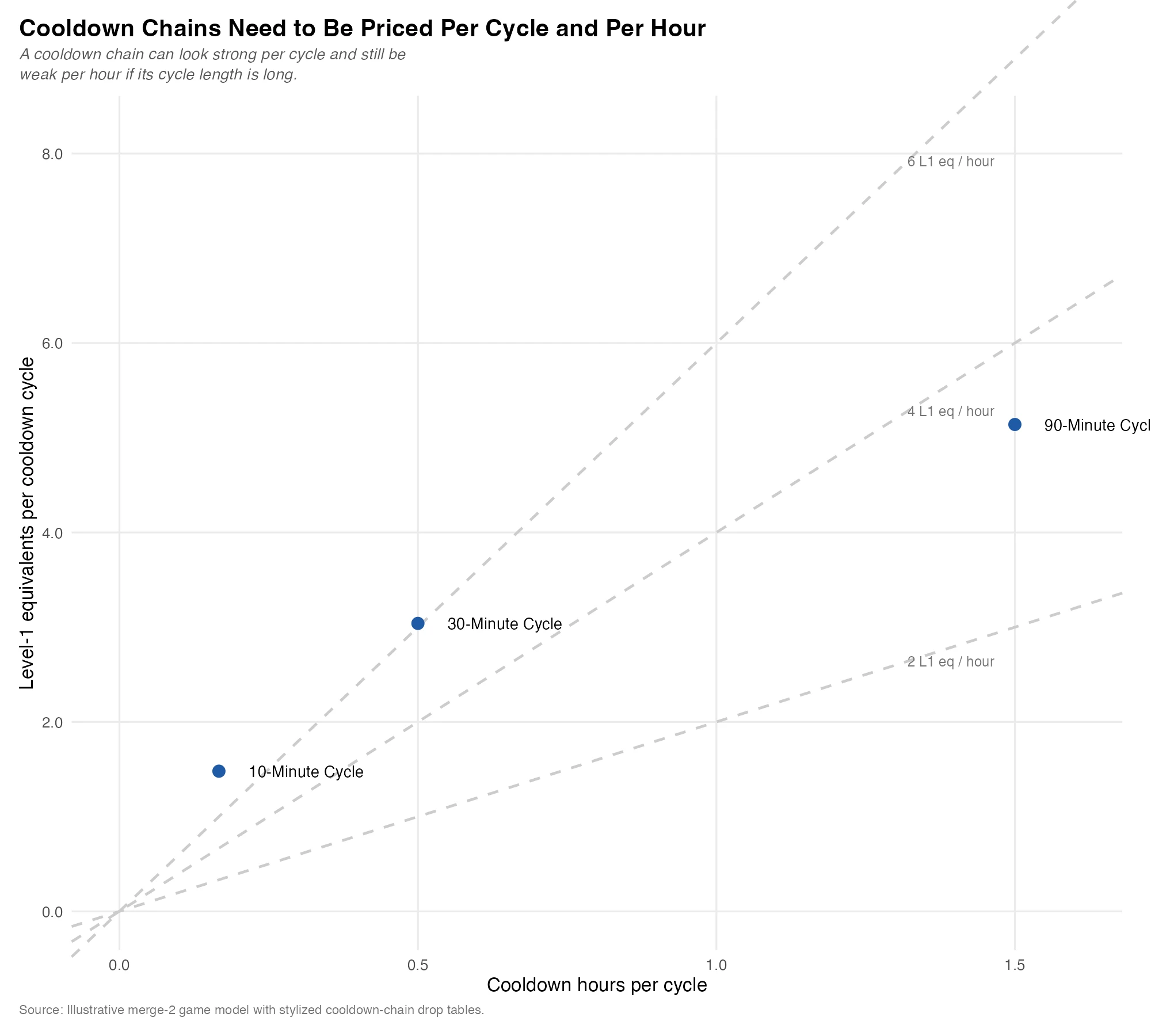
This matters because cooldown chains, like the Orange Tree item merge chain, still pay coins and still move the meta, but they do so on a different efficiency frontier. They themselves will only generate a fixed amount of items until they go on production cooldown, and less hard currency is spent to reset them.
\[\text{expected merged item level per cooldown cycle} = \sum_s \text{p of item level } s \cdot s\]
\[\text{expected level-1 equivalents per cooldown cycle} = \sum_s \text{chance of item level } s \cdot 2^{s-1}\]
\[\text{expected level-1 equivalents per hour from cooldown chain } c = \frac{\text{expected level-1 equivalents from one cooldown cycle}}{\text{cooldown cycle length in hours}}\]
\[\text{cooldown-time burden of an order} = \sum_{\text{cooldown chains in the order}} \text{required level-1 equivalent demand} \cdot \frac{\text{time per cycle}}{\text{expected level-1 equivalents per cycle}}\]
If a cooldown cycle drops a bundle instead of one item, the same math still works. Just add up the level-1 equivalents inside the bundle before taking the expectation.
That is why cooldown generators matter even if storage is not the main monetization vector. They change the mix of wait time and energy time inside the queue; they slow the player through waiting rather than pure energy spend, and may price time separately. This is really important for live ops events. Designers may want to charge a different currency price per cooldown generator reset.
This is also how we can speak about the order queue: some orders are mostly energy merge problems (time + merge action), while some orders are wait-time problems (time).
Board Efficiency
Board efficiency determines how much of the player's board actually advances order progress. A board space taken by a Level 10 Dog no one wants reduces efficiency.
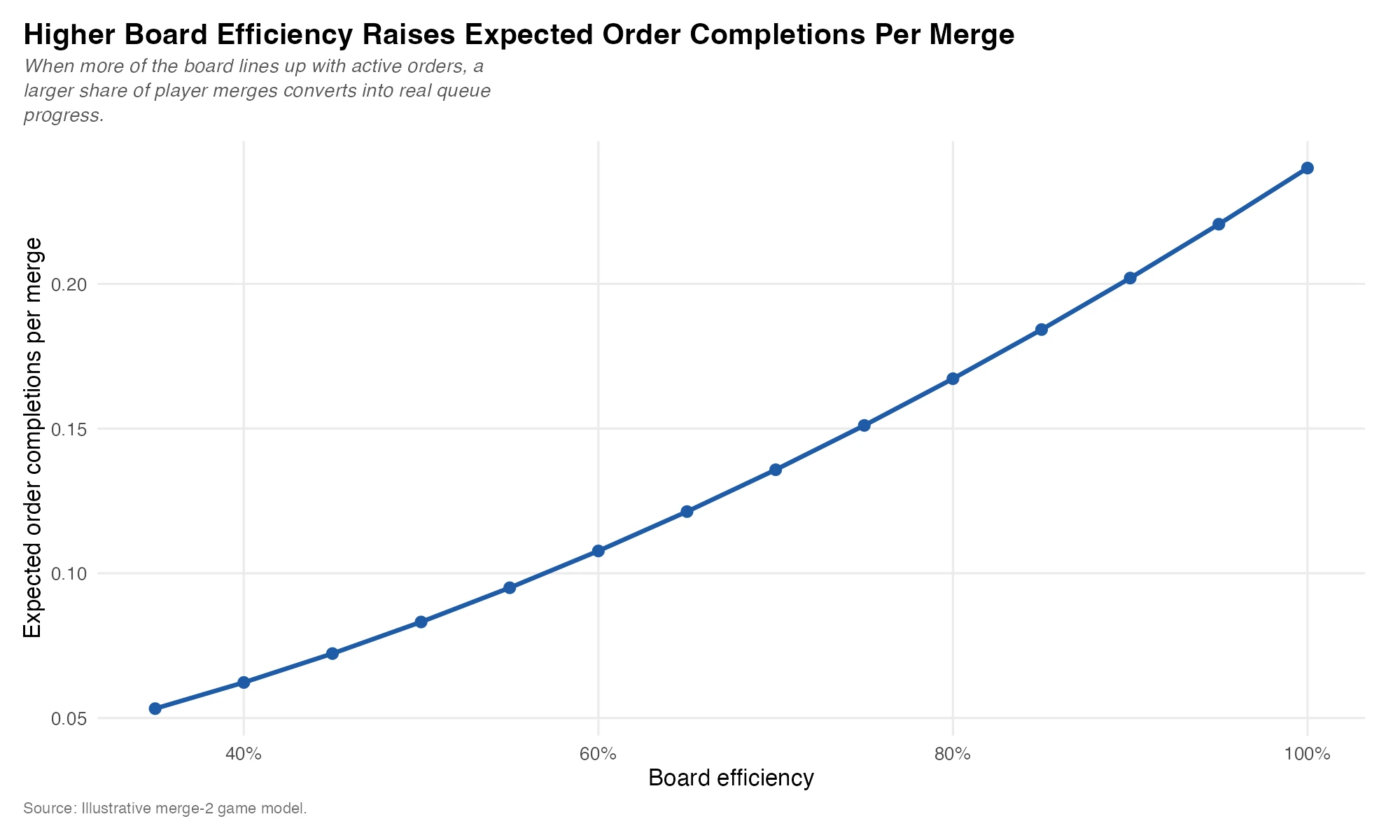
\[\text{board efficiency on day } t = \frac{\text{level-1 equivalent production that actually advances current orders}}{\text{total level-1 equivalent production created on the board}}\]
If the player creates 100 level-1 equivalents and only 70 level-1 equivalents actually move active orders forward, board efficiency is \(0.70\). When the board is clogged with low-level scraps, blocked merges, side-chain junk, or sold throwaways, board efficiency falls below \(1.0\). When the board is clean and current production lines up with the queue, it moves closer to \(1.0\).
That is the same pain players are describing in threads about boards being filled with generator pieces or always full. Board efficiency is also a function of the relative items the order queue is asking for. As board efficiency rises, a larger share of the merges the player makes actually advance active orders, so expected order completions per merge rises too.
Order Completion
With those pieces in place, order completion is just constrained production:
\[\text{orders completed on day } t = \text{board efficiency on day } t \cdot \min_{\text{across required generators}} \left( \frac{\text{level-1 equivalent supply produced by that generator on day } t}{\text{level-1 equivalent demand placed on that generator on day } t} \right)\]
In the baseline case:
\[\text{level-1 equivalent supply from generator on day } t = \text{energy spent on generator} \cdot \text{expected level-1 item equivalents per energy spent}\]
This is just the same generator idea as above. If the order queue asks for several bakery items and one Orange Tree item, those are different generators, and each generator gets its own level-1 equivalent demand total. This is a better way to talk about variety.
Variety does not just mean more items, it means more generators in the denominator, which raises the odds that one weak generator throttles order completion, and thus slows the queue. The order slot cannot turn over to new item requests that reward gold and clear board space.
It also makes the bottleneck logic explicit. The player progresses at the speed of the most constrained generator in the item order request set, rather than the speed of the average generator.
The Queue
Orders do not arrive one at a time in a vacuum. They sit inside an active queue, and mostly each open slot rolls a replacement order after it is cleared.
Based on the Gossip Harbor research, the standard order queue does not appear to look at the live board and then generate custom counter-orders. But the system obviously has to know which generators the player has unlocked, because new players cannot be served impossible requests.
So the clean claim is not "fully random" and not "fully personalized." The clean claim is that merge games use progression-segmented global order tables. As meta progression advances, new generator levels unlock and the relevant order-weight table might change with them.
\[\text{order progress already sitting on the board} = \frac{\text{level-1 equivalent items on the board that satisfy the order}}{\text{level-1 equivalent items required by the order}}\]
\[\text{order progress remaining} = 1 - \text{order progress already sitting on the board}\]
This is the simpler way to think about the queue: it changes board efficiency through order progress already sitting on the board. If the queue lines up with what the player already has on hand or is already producing, more of the board's output counts as useful progress and less progress remains. This also means efficiency increases as the number of order queue items increases. If the queue item requests become more exotic, board efficiency drops.
That is why a wider queue can accelerate progression. More active slots means more chances that one open order naturally matches current inventory or current work-in-progress.
It is also the obvious future design space. In match-3, adaptive drop changed the economy by reading the board state and steering supply. Merge games could do the same thing by reading the board before rolling replacement orders. If Gossip Harbor Reddit threads are correct, the standard queue does not seem to be doing that yet, but it is an obvious place for the genre to go.
Even without board reading, the queue still reshapes session economics.
The Exploration Space
This leaves a design space that feels underexplored. If some merge games are not already doing it, they should probably play more with per-item or per-generator energy boosters than with blunt board-wide ones. Those are more precise because they let the player buy down the exact generator where exponential demand is binding. Why can't I boost my Coffee production for a set amount of time?
The more advanced generator-side questions sit one layer deeper than this post. I am saving drop-table upgrades, power progression, and multiplier clipping for a follow-on piece.
Putting It Together
The combined daily model is:
\[\text{meta progress on day } t = \frac{\text{expected coins per order on day } t}{\text{coins required for the next meta step on day } t}\cdot \text{board efficiency on day } t\cdot \min_{\text{across required generators}} \left( \frac{\text{level-1 equivalent supply on that generator}}{\text{level-1 equivalent demand on that generator}} \right)\]
Progress accelerates when orders pay more coins, when the next meta step is cheaper, when the board's items progress the current order item request, when the drop rate of item levels inside a generator increases, or when the weakest required cooldown generator increases production.
The genre monetizes the spread between exponential order demand and the player's ability to compress that demand through generator power, board space, cooldown management, and time. As a fundamental departure from match-3, things like Super Light Ball and Toon Blast Disco Ball have yet to be discovered in the genre.