What Merge-2 Economics Is Missing
The Economics of Merge-2 Games argues that Merge-2 represents a fundamental break from match-3 by focusing on the compression of time and space into the core design mechanics: merge levels, cooldown resources, and order queue design. Yet, there's even more peculiar space to explore:
- What do generator level-up drop tables actually buy?
- When can efficient generators offset energy-intensive orders?
- How does multiplier scaling hit a ceiling once output starts clipping?
Generator Level-Up Drop-Table Shifts
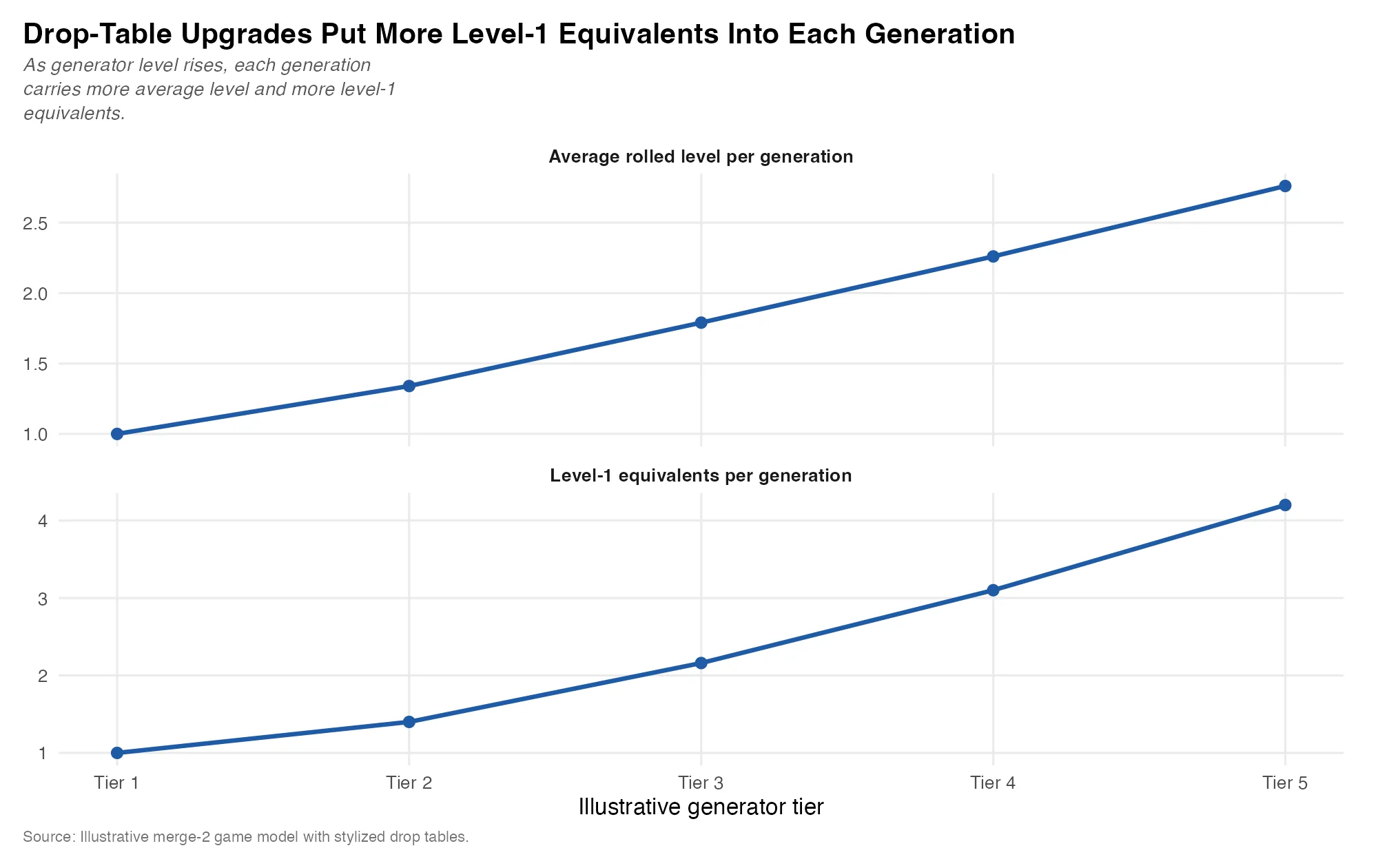
The big efficiency lever is the generator's drop table for items of a given level: generator level-ups shift what the generator can roll in the first place.
At generator level \(h\), the generator rolls item levels with different probabilities. The expected level for any generation is given by:
\[\text{average rolled level from one generation at generator level } h = \sum_s p(s \mid h)\cdot s\]
Here \(s\) is the possible rolled item level, and the weights \(p(s \mid h)\) change as generator level \(h\) changes.
Yet, because each merge level doubles value, the thing that actually matters is the number of level-1 equivalents produced by one generation:
\[\text{expected level-1 equivalents from one generation at generator level } h = \sum_s p(s \mid h)\cdot 2^{s-1}\]
This is what generator upgrades are really doing: they shift the drop table upward so that each generation carries more level-1 equivalents, making the generator more efficient per generation and per unit of energy spent. Unpegging this value, as multipliers do, opens a large design space that could push merge-2 further toward the slots domain.
If one generation from that generator costs \(e_h\) energy, then:
\[\text{expected level-1 equivalents per 1 energy at generator level } h = \frac{\text{expected level-1 equivalents from one generation at generator level } h}{e_h}\]
\[\text{expected energy needed to produce a target that requires } D \text{ level-1 units} = \frac{e_h\cdot D}{\text{expected level-1 equivalents from one generation at generator level } h}\]
\[\text{expected energy needed to produce one level-}L \text{ item} = \frac{e_h\cdot 2^{L-1}}{\text{expected level-1 equivalents from one generation at generator level } h}\]
That is the efficiency gain from the drop table itself. A higher-level drop table, and thus more level-1 equivalents per energy, lowers the expected energy cost of orders because it gives the player more level-1 equivalents each time the generator fires.
Power Progression
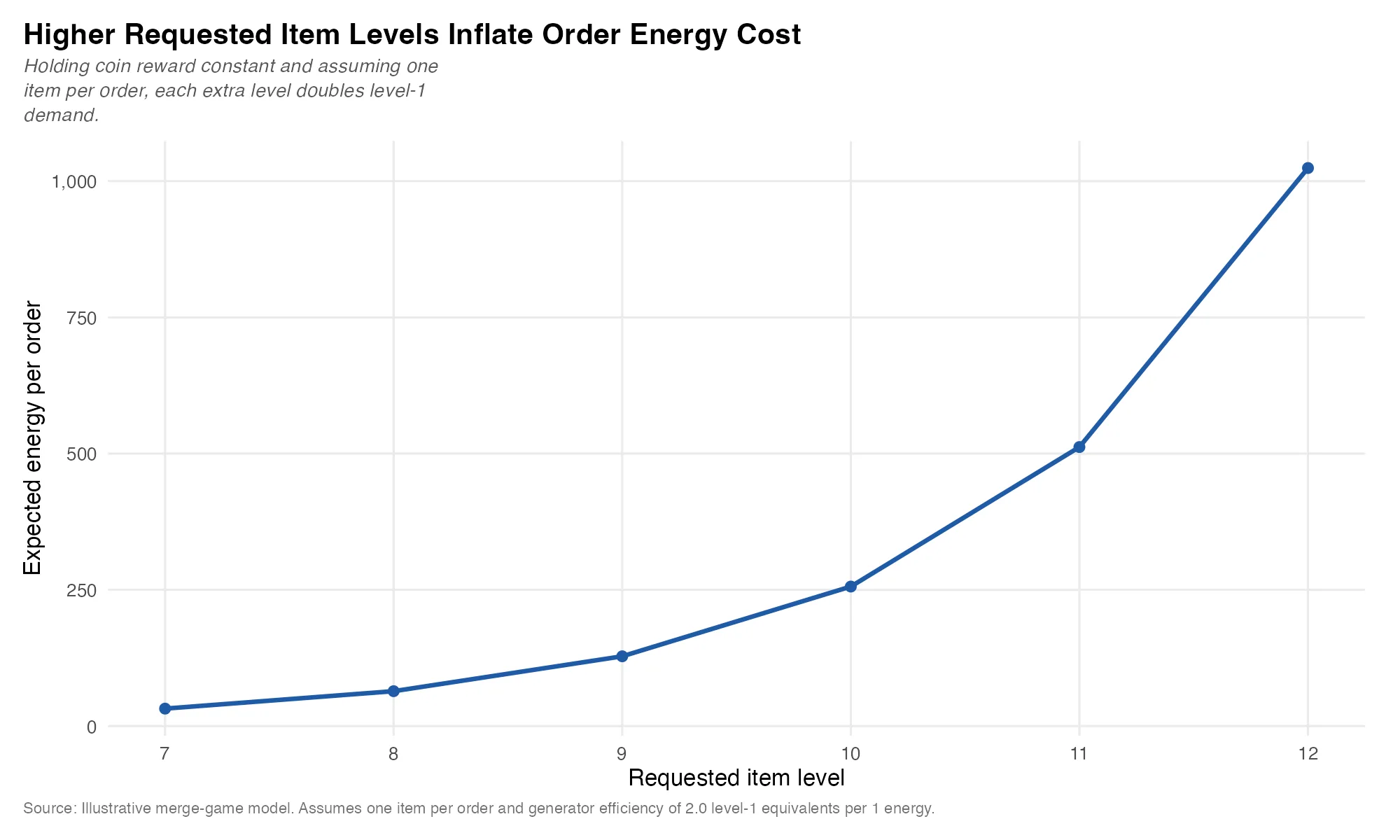
Raising requested item levels directly raises the energy needed to clear the order.
\[\text{expected energy needed for one order} = \frac{\text{level-1 equivalent demand in the order}}{\text{expected level-1 equivalents per 1 energy from the required generators}}\]
Pinning one level-1 item to one energy is a foundational merge-economy design choice. If higher generator levels raise the expected number of level-1 equivalents per unit of energy spent, then the economy gains a long-run efficiency layer. These are permanent generator-efficiency upgrades. It is a huge risk for designers to change this, since it affects the player's entire lifecycle: the board doesn't reset like in match-3. Ever.
\[\text{orders completed per day} = \frac{\text{daily energy budget} \cdot \text{expected level-1 equivalents per 1 energy}}{\text{level-1 equivalent demand per order}}\]
That is the heart of the power progression economy. If order energy demand grows faster than generator efficiency, progression slows. If drop-table upgrades push more level-1 equivalents into each unit of energy at roughly the same pace that order demand rises, more efficient generators can offset more energy-intensive orders.
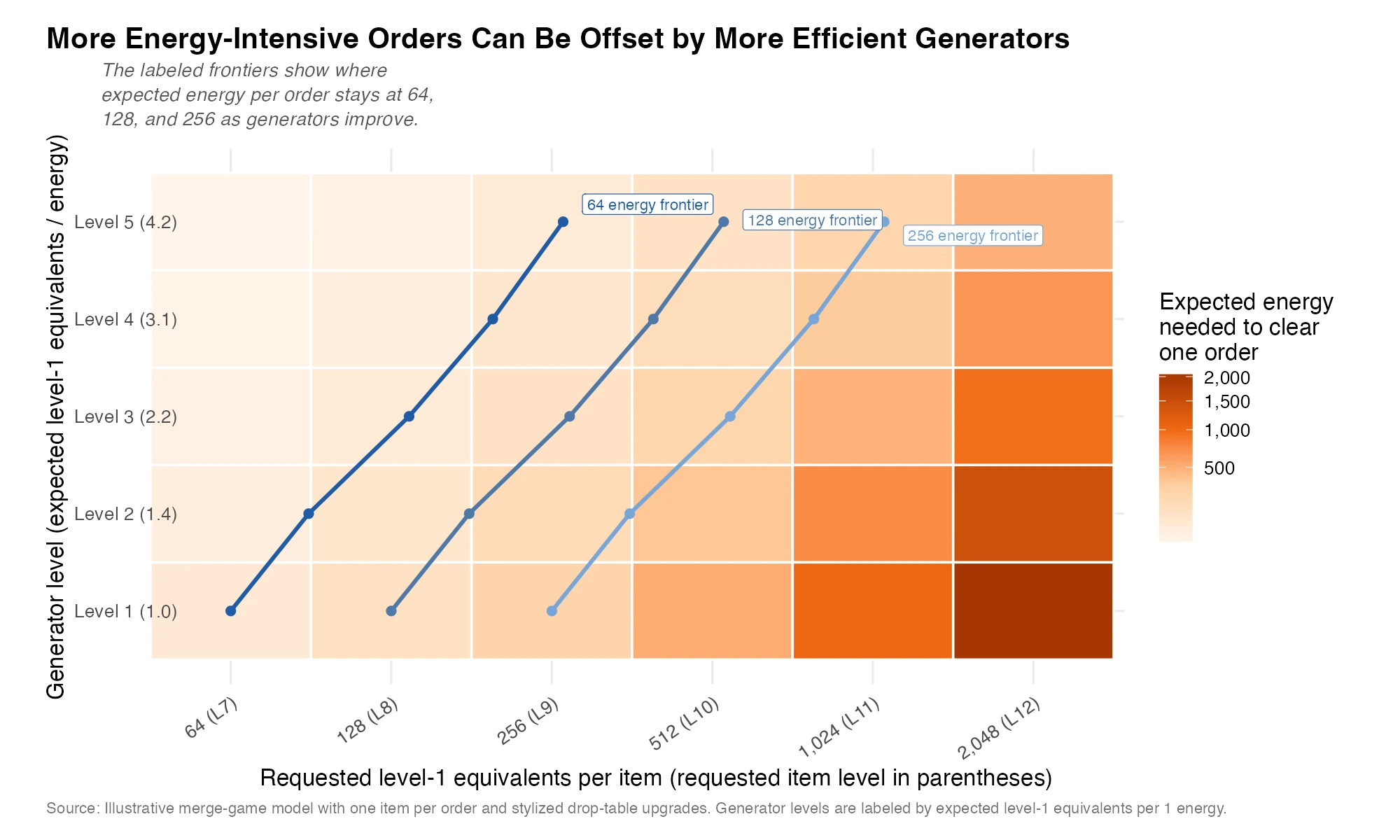
This is also where merge starts to look like a power progression economy. Designers can keep raising order demand while moving generator drop tables further to the right. If those two curves rise together, the player can keep seeing higher-level requests while expected energy per order stays roughly constant. If they drift apart, the economy turns punitive fast. This is also how slot economies manage inflation, punishing players for holding assets over time. As order energy requests increase, the purchasing power of energy decreases as each unit satisfies fewer orders, and that means there are fewer coins or less meta progression per energy unit.
Another suggestion that falls out of the model is something match-3 adopted, which is spiking newly released meta content costs, that is, more meta coins to progress each day, then decreasing them as the content ages and the player state increases for new players who experience it.
Clipping & Deadweight Loss
The multiplier discussion gets more interesting once the output ladder stops being infinite. Consider that the multiplier is applied after the generation roll occurs on each generator. In the clean version of the system:
- \(1x\) adds \(0\) levels
- \(2x\) adds \(1\) level
- \(4x\) adds \(2\) levels
- \(8x\) adds \(3\) levels
That means:
\[\text{added levels from multiplier } \mu = \log_2(\mu)\]
\[\text{realized item level after multiplier and clipping} = \min(\text{rolled item level} + \log_2(\mu), \text{maximum available item level})\]
\[\text{realized level-1 equivalents from one generation after clipping} = 2^{\text{realized item level after multiplier and clipping} - 1}\]
\[\text{expected level-1 equivalents per 1 energy with clipping} = \frac{\text{weighted expected clipped level-1 equivalents from one generation}}{\mu}\]
If rolled level plus added levels exceeds the maximum available item level, the item level gets "clipped" to the maximum level. Part of the paid multiplier produces no additional useful output: a deadweight loss in some sense. If clipping pushes the player onto an item level no active order currently accepts, the player can pay for output that neither improves per-energy efficiency nor helps queue progress.
In the no-cap generator level-up efficiency model, level-1 equivalents per energy stays flat. The downward bend only appears once the multiplier starts pushing rolled items past the maximum available level.
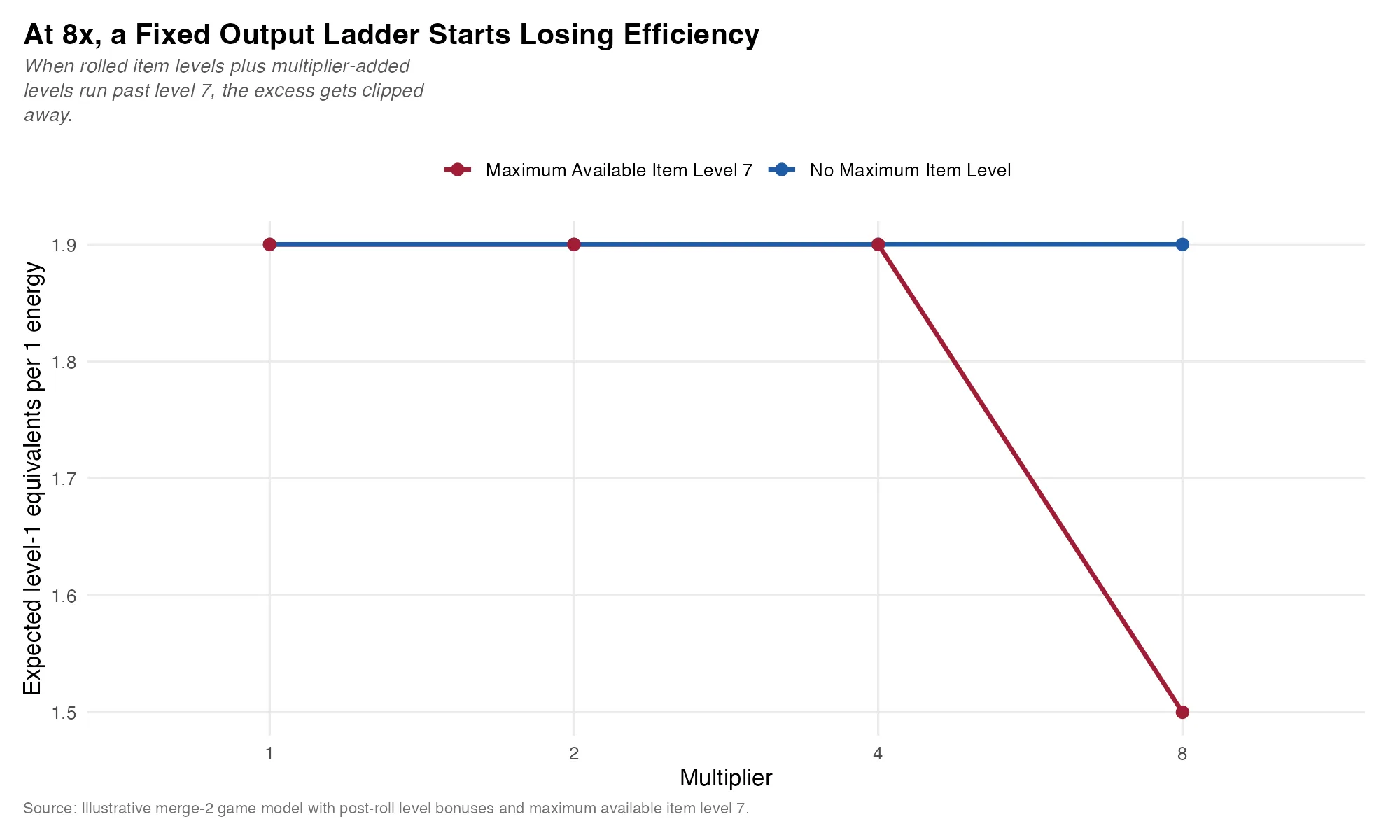
The design implications are straightforward. Anytime clipping occurs, the game should automatically refund the wasted share of energy. Additionally, players should be able to turn multiplier behavior on or off for particular generators instead of being forced into one blunt mode.
What the Genre Should Try Next
The deeper generator-side lesson is not just that merge games sell more energy. They sell more efficient energy, and that creates a wider design space than the genre currently uses.
- Per-generator or per-item boosters are better than blunt board-wide boosts because they let players buy down the exact generator where exponential demand is binding.
- Clipping should refund wasted energy automatically.
- Players should be able to turn multiplier behavior on or off for particular generators.
- Merge games should experiment with selling MetaCoins directly, not just energy, cooldown skips, and item shortcuts.
- A battle pass should grant an additional active order slot, because a wider queue increases board efficiency by increasing the chance that current inventory or current work-in-progress lines up with at least one order.
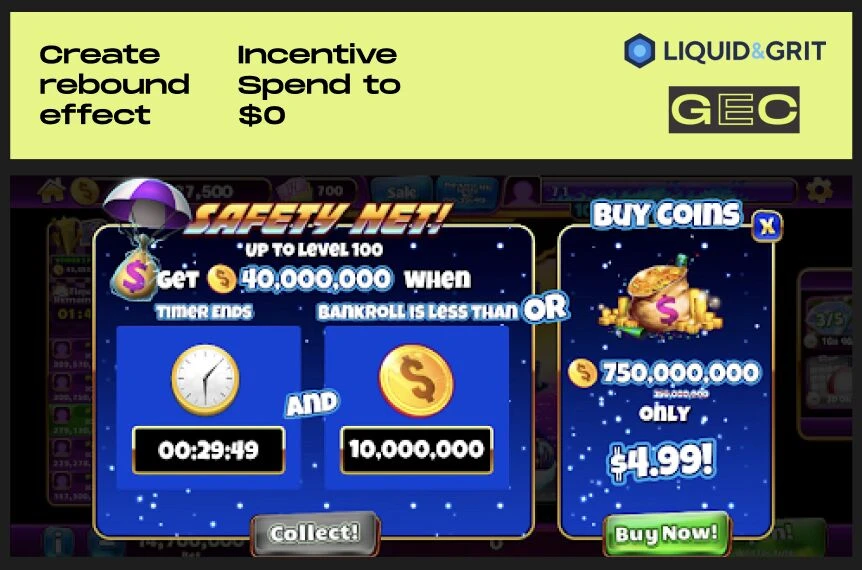
- Merge games should experiment with a parachute after zero energy, where the player re-enters on a cooldown with a limited amount of playable energy. That would push the genre further toward the social-casino safety-net playbook without forcing a full fail state.
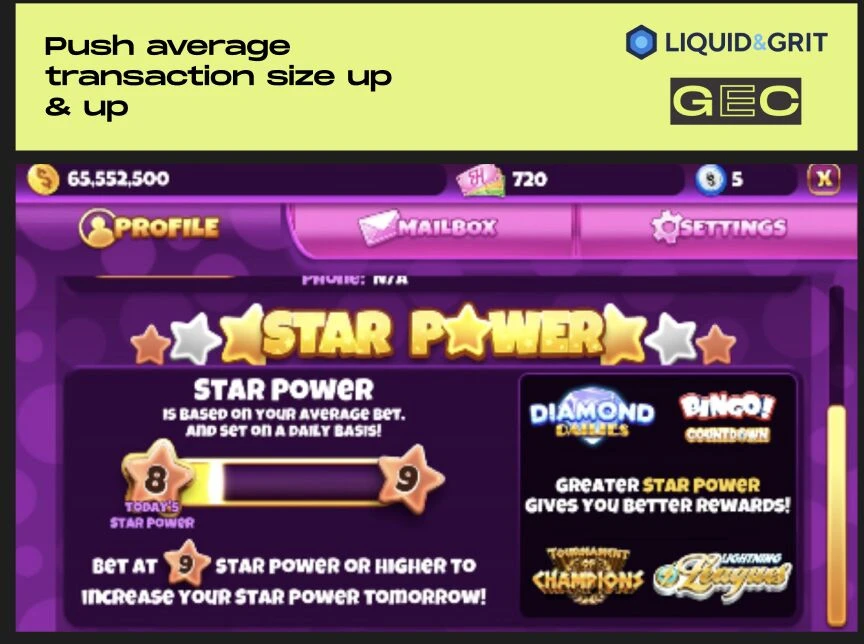
Social casino already has two cleaner spend-velocity mechanics worth borrowing. Safety Net gives the player a rebound grant after hitting zero, then re-enables that claim on a cooldown. That makes full balance drains part of the rhythm instead of the end of the session. Star Power rewards players for raising average transaction size, which turns higher spend velocity into a small progression track with built-in crescendo moments. Merge and match-3 should probably borrow more from that playbook than they currently do.
There is also an experimentation layer sitting underneath all of this. If Experiment With Seeds, Damn It is right that seeds are one of the least acknowledged but most powerful design variables, merge games should treat generator drop tables and order-table rolls the same way. Both systems are seeded randomness. Teams should experiment with per-player lifetime seeds or seeded order-and-drop-table regimes, measure which seed families retain best over time, and then promote the strongest seeds into defaults.
Of course, the question of more conditional weighting on order queues remains the most pressing area merge-2 games need to explore.