Fuck Social In Games
No word in games is more routinely abused than "social." PMs and designers routinely give the word communion, as if saying it three times makes it magically appear. Yet, when you deconstruct the feature, social usually means a chat window and clicking a button to send currency to another player (looking at you, match3). Spicier implementations might have group missions! ...that are really just individual activities summed across each clan player. This is not social! It is communication with a rewards wrapper, and it has almost nothing to do with why 4X and many MMOs generate incredible spend, retention, and memorable moments that players talk about for years.
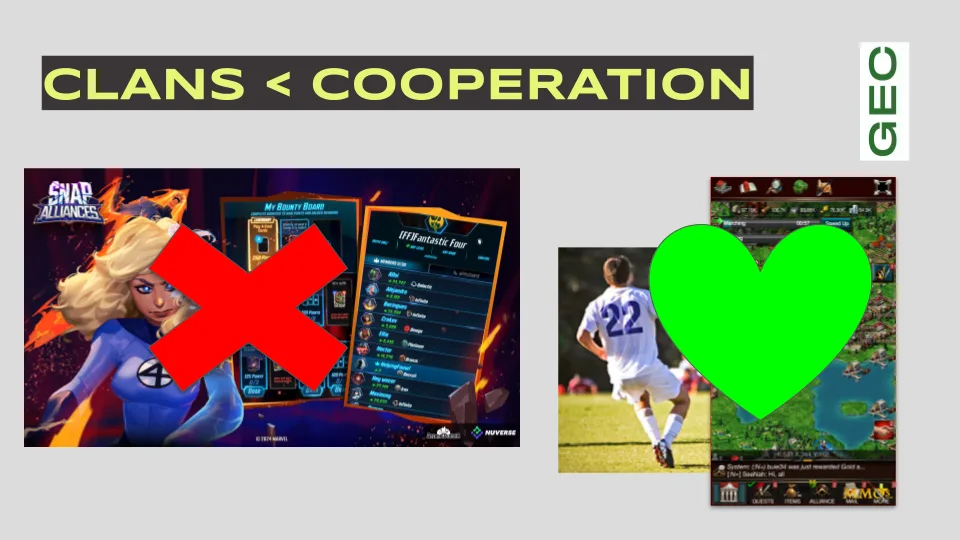
The defining characteristics of social in gaming are coordination and cooperation.
The clearest example is 4X. To take the seat of power on a world map, players need to cooperate by donating resources and strengthening the clan. Machine Zone founder Gabe Leydon once said that a $1,000 dinner bill looks expensive until you realize you're paying for ten other people. Players willingly subsidize others because the system makes progress contingent on synchronized group action. Without it, the group fails.
It's not simply spreading the resource love that grabs the seat of power. It's also coordination. Players need to time attacks and marches against rival clans, and to synchronize to achieve the goal. It's the combination of these two things that has unlocked what is quickly becoming mobile's biggest genre.
Soccer is another great example. There is one ball, and everyone wants the same outcome. No individual, no matter how talented, can score consistently without modeling others' intentions, positions, and timing. Success is inseparable from coordination and cooperation.
Monopoly Go's partner is a smaller-scale example of this. Coming out of economic ultimatum games, Partner events set up four donation stations at the center of the board. At each donation center, two players are paired. They share a progress bar that fills up once each player donates an event currency. Given the four stations and four different partners, players donate to a station that another player has also donated to, creating a tit-for-tat strategy game and essentially gamifying traditional economic games in a way that economists have failed to advance and economic designers have failed to study. But this, of course, requires coordination as well, and it requires feelings of reciprocity that, again, are separate from players acting individually and then cumulatively adding numbers together. The big irony here is how we can design games that are social, not as feature addenda.
The biggest social whiff has undoubtedly been in serving female gamers. The assumption that this audience's needs and wants boil down to match3 is lazy and wrong. No one has been able to design a female casual game that puts social described in this way at its core.
We know how to design true social, and keep choosing not to.