Battlefield Portal, and the Unfinished Re-Baptism of Battlefield
Battlefield 6 did the impossible by outselling (or at least from what we can tell, getting very close to) Call of Duty sales on a down year. Repeating what we saw with Battlefield 1 and Call of Duty: Advanced Warfare, but, like most Battlefields, it's struggled to gain a foothold in live service.
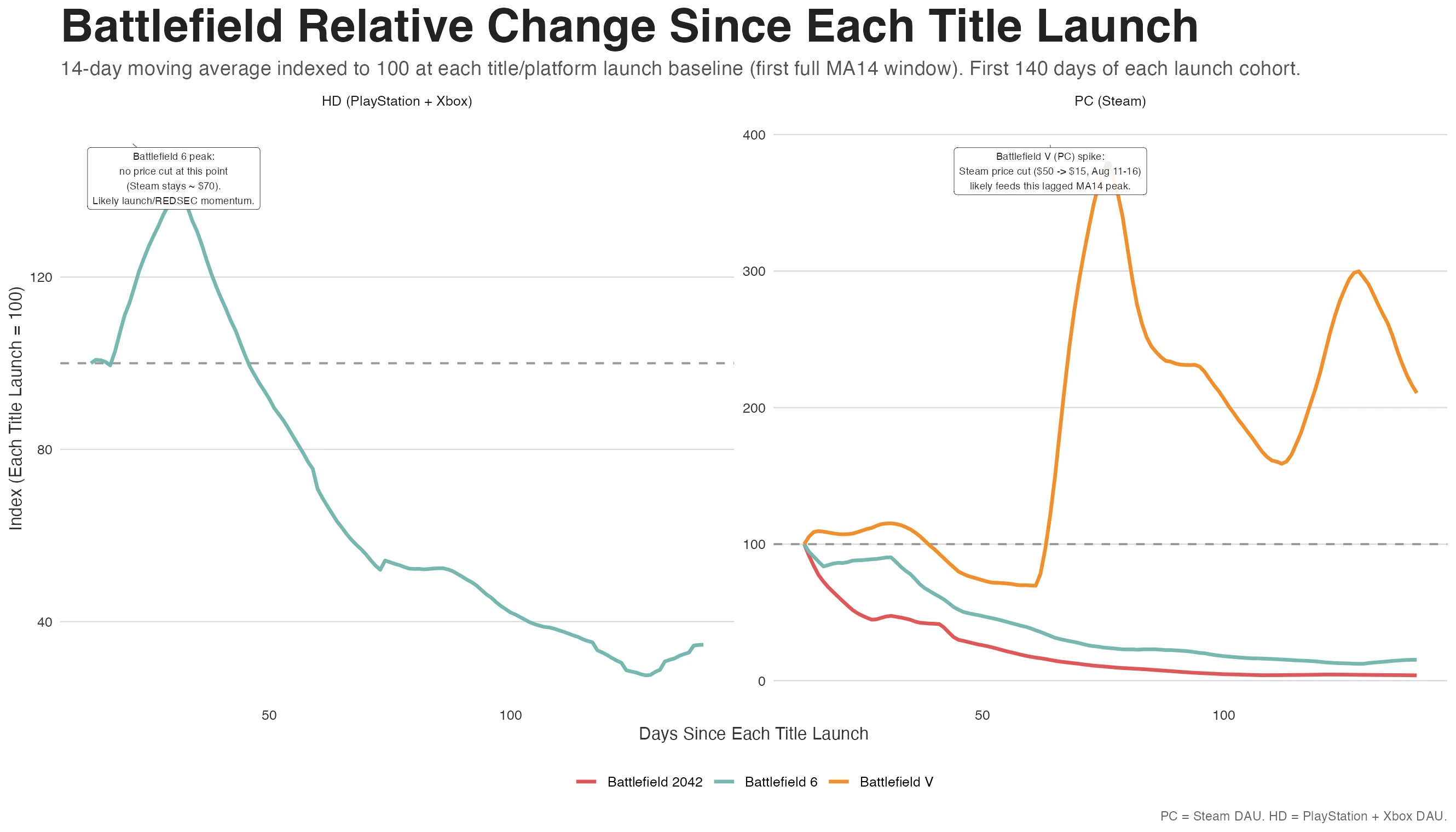
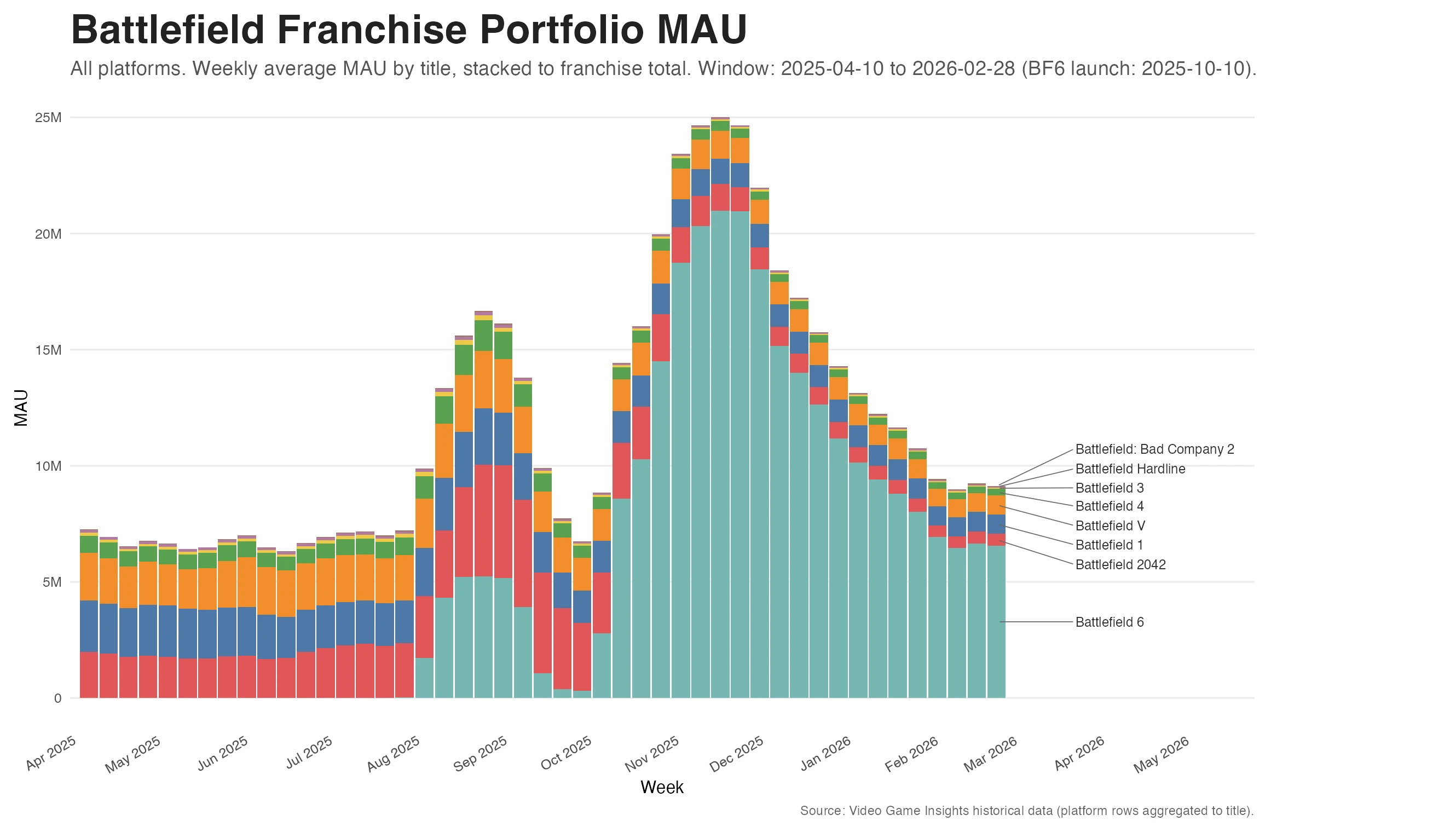
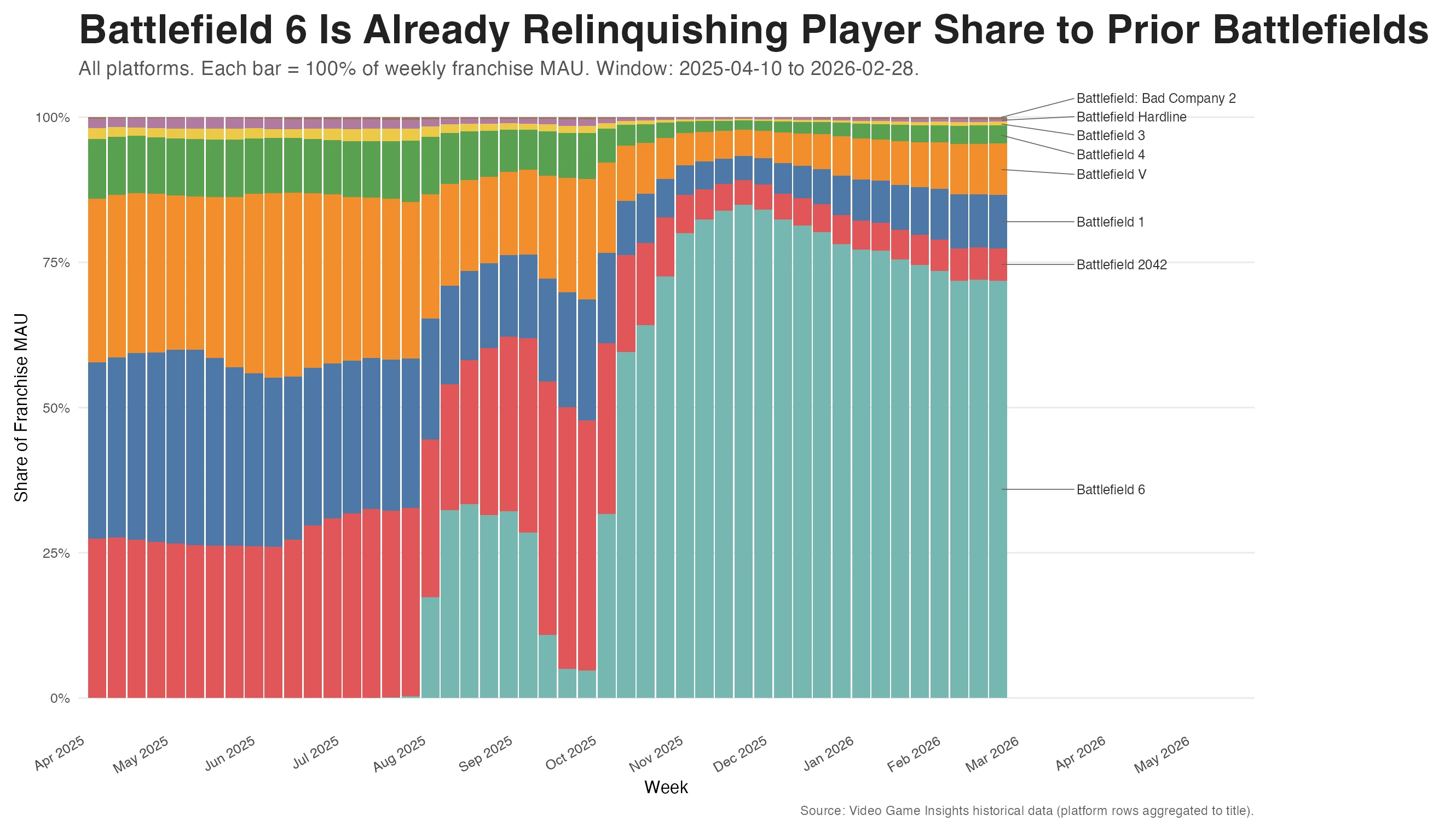
The team, LA-based and largely Call of Duty leadership, ran the Call of Duty playbook to a T when it comes to monetization, selling blueprints, main interface design with a tile UI, and gun attachments. We even see elements of Call of Duty's mastery camo challenges appear. There are a bunch of new elements, too, that made it into the title. Like in-round progression, Field Upgrades, that move players up a linear ability path in a single life. So far, the game has been struggling to find "productive" content, and I'm concerned it may not be able to cover its variable costs each month. If it can't fulfill this equation, it can't sustain a service. Beyond fulfilling some implicit box-service expectations, it's time to pack it up and move on to the next Battlefield. The curious question is why Battlefield Portal hasn't lent a stronger hand.
Battlefield Portal, first introduced in Battlefield 2042, is an answer to one of the long-standing challenges it and Call of Duty grapple with: how to ensure content produced buys enough retention or stacks up in a way that lasts until the next one drops. On a first-principles approach, we can think of the base game as providing a certain number of retentive units. But as the bulk of players hit the end of that curve or repeatedly replay certain loops, active users are whittled down if the ongoing install base and the retentive units of fresh cohorts are unable to replace them at a sufficient rate.
Portal unlocks the ability for players to create their own units of retention, which should be a massive supply-side to combat the content problem. It is the dark horse answer to Western cost profiles; we're outsourcing to the largest possible TAM. This started in Battlefield 2042 with an impressive web-based logic editor, harkening back to the days of Battlefield's Uprise UI. And now, Battlefield 6's Portal includes much deeper engine integration, allowing the movement of actual objects, enabling the recreation of old maps like Call of Duty's Shipment and prior Battlefield maps. It's an old idea that games like Halo's The Forge first started to really play with in shooters, but it doesn't feel like it has been a growing paradigm.
But for all this seems to solve on paper, Battlefield 6's DAU is still dropping, and Portal hasn't been enough to stem it. The question is why? Part of the answer is straightforward: they've had to limit certain XP values. The fear is that players would find easy ways to farm high XP per minute areas. Of course, this has always been a problem, harking back to why players like small maps like Metro with few defined choke points: kills increase, which increases score, which then translates to more XP. It's like going to the gym.
On the other hand, I'm not so sure I've ever believed this is a problem, and perhaps gaming XP is part of the mode's appeal. They've tried to solve this with "Verified Experiences," a curated list of full XP community settings, but who knows what share of Portal DAU that comprises. Instead, a simple set of hard back-end caps can limit the truly crazy stuff, and use that as your wage ceiling, and let players "game" the system. The difference between the hard cap and what players normally earn in the made modes becomes a wage premium. And that's okay, too, for driving players to the mode. As the UI placement is so poor, I actually didn't even know the mode existed after playing the game for a month. This should at least raise the mode K-factor.
Beyond XP fixes, there are still fundamental problems in Battlefield's core loop. For instance, a few players soak up all Conquest kills, leading to highly unequal K/D between players. It turns out players like shooting things and not getting shot.
Additionally, its content is "unproductive" at the margin. For instance, maps are extremely expensive and yet only provide a couple of percentage points in week-over-week retention boosts. Which, when translating to an uplift in marginal revenue, is pathetic. With guns, players only date them for a fling before returning to their main boo. And don't get me started on vehicles that only a very small share of players play. This has also been a recurring problem with class-based content. Distinct classes also effectively reduce your content's total addressable market by 25% if there are four classes.
The addition of those Mastery Challenges and gun attachment progressions also doesn't seem to have done enough to get the game to a steadier player equilibrium quicker. And that's okay, given how much progress was made on this Battlefield. But for the next iteration, Battlefield Studios needs to start going after some of the problems with the franchise.
The game needs to be re-baptized around the team structure and the importance of a single life. Chris Anjos has called this, and what Call of Duty represents is the ability to be an action hero. I think Battlefield provides its own version of this, but so far, that spectacle has brought in a heaping load of box sales but little retentive units. Elements like body dragging, which we were never able to execute in earlier versions of Battlefield, are done here. It's one of those key moments that feels just right in the game, and epic to drag a downteam teammate out of fire and revive them.
The game struggles to build a cohesive squad player, and despite the introduction of in-round progression for individual soldiers, spawns still feel empty. I'm still seeing issues like players not saving one another or Medics ignoring you. The element of reinforcements that were starting Battlefield 5 provides an interesting view, where collective Squad Points can summon powerful flamethrower tanks, similar to what it was. The game still feels best when a squad can make deliberate, obvious progress across a session's ruleset.
Simple in-round orders could also go a long way, which, when a squad leader uses Battlefield's original Comma Rose ping system, actually directs player action. If there's anything I've learned over the last five years of game design, it's that simple goals direct player action. There's far too much going on in the UI to expect players to make map reads every spawn, and instead, the game needs to choreograph to help coordinate different teammates.
While the game struggles to do matchmaking at all, given the large server sizes required, simple squad sorting rules and pairing players of similar playstyles together are about enhancing teamwork and achieving group objectives.
From what I understand, the internal forecasts were wild, and RedSec (again, going back to the Warzone playbook) was a repeat of Battlefield V's free-to-play attempt, Firestorm. There's just not enough there to justify its existence yet.
The game's promise of all-out warfare remains the franchise's defining feature, but an addendum to the Battlefield constitution, with a focus on the meaning of the squad, is needed. Directed play will help build and expand the audience, just in time for Battlefield 7, which this team will start exploring.