Artists & Two Deaths Killed Western Game Development, but Engineers Can Save It
By Phillip Black. Also published on Deconstructor of Fun.
Gaming used to be the first thing every new technology touched. Real-time 3D graphics, physics simulation, haptic feedback, in-app payments, VR headsets, and yes, even web3: games were the popularizing use case! Even AI itself was subsidized by 20 years of gamers buying Nvidia graphics cards. Yet we've completely and demonstrably failed to embrace AI... until a turning point in November. The failure to embrace AI at its onset isn't just a bump in the road; it represents a radical divergence in who is making games, and it explains why Western game development is quickly moving to the Endangered Species List. There's something rotten in the state of game development, and Two Deaths in the Family explain why.
We Argue, the East Ships
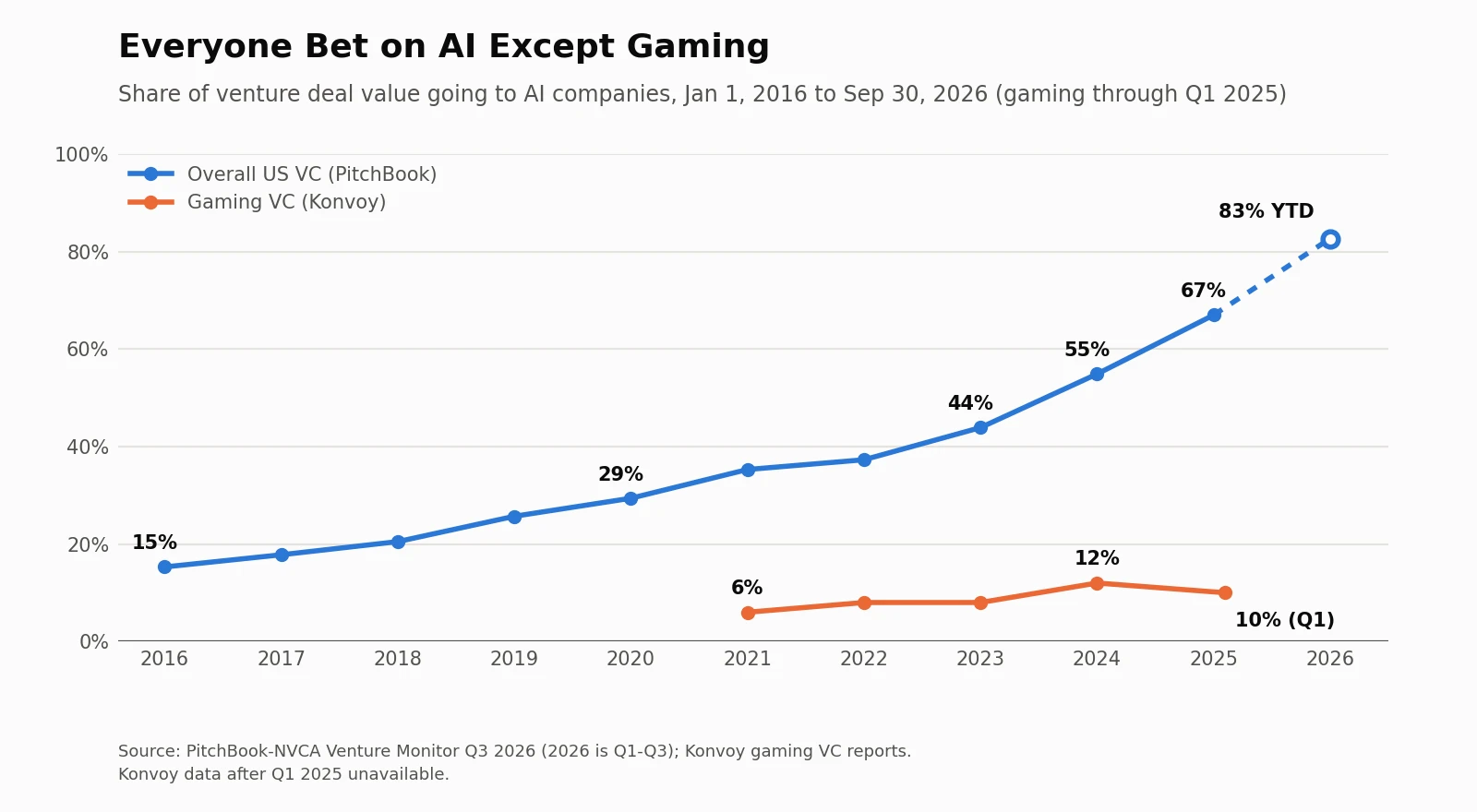
Start with the money. AI went from 15% of all venture deal value in 2016 to 83% in the first three quarters of 2026, while AI's share of game investment never broke 12% (PitchBook-NVCA Venture Monitor and Konvoy). In February 2025 I wrote that AI in gaming has flopped: in the 26 months after ChatGPT launched, web3 made more tangible progress in games than AI did. The money followed the mood, and the mood is worse than indifference.
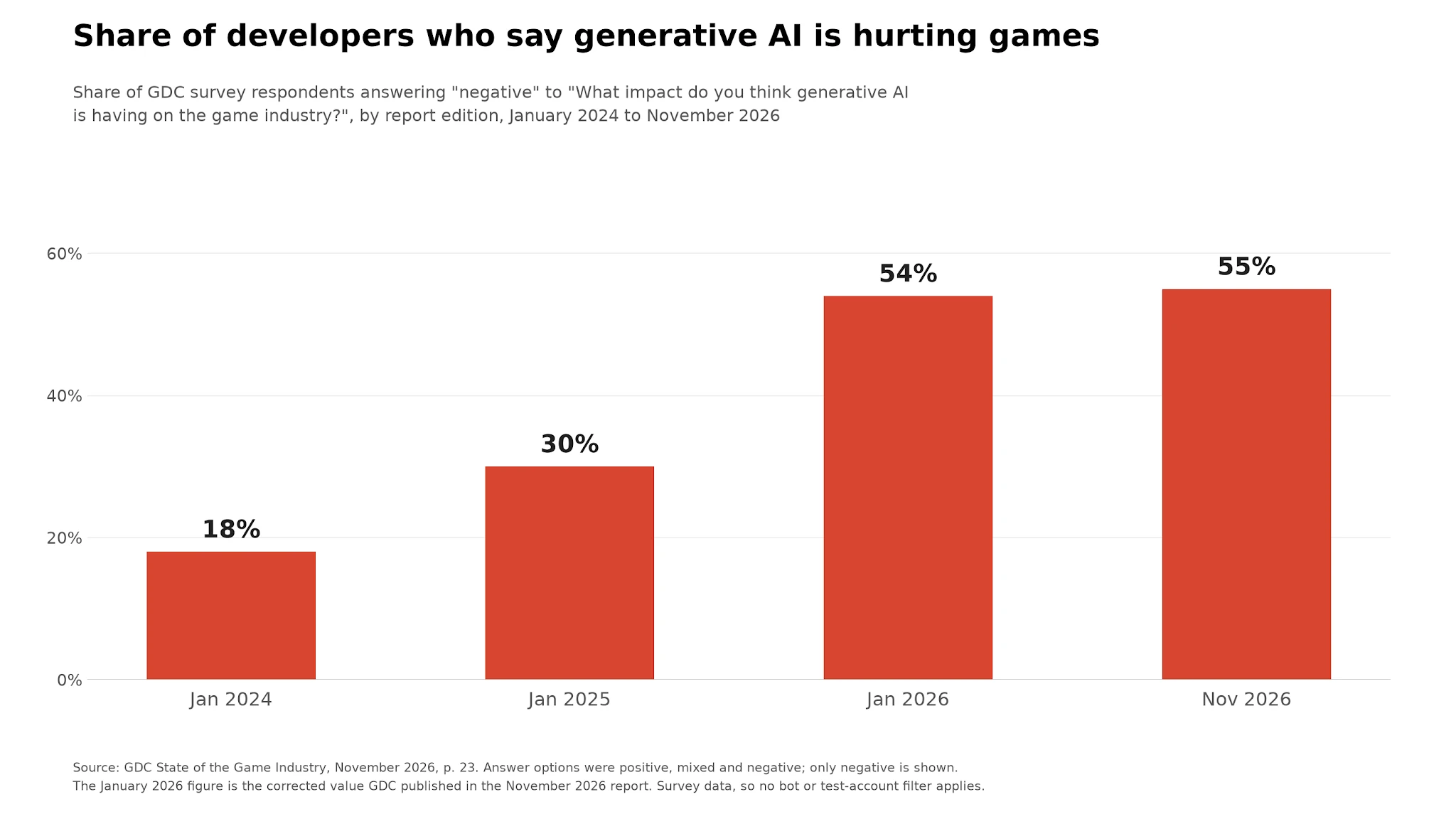
GDC's November 2026 survey of mostly Western developers found 55% think generative AI is harming the industry, up from 18% in 2024.[1] Among visual and technical artists, 65% said it was harming the industry. 8% said it helps, eight percent! Obviously, these numbers don't reflect these developers' day-to-day workflows; instead, they reflect what political scientists call "expressive responding": answering a survey to show which side you're on rather than what you actually do. And on this, there's no better contrast than Eastern development.
Japan's CESA survey of over 1,000 devs found 86% use generative AI at work, with 63.0% using it daily, while China's Game Publishing Committee survey reported 86.4% of companies apply AI in production. Hell, Korea is so in that Krafton bought its own GPU cluster.
Over and over again, the complaints have come from one discipline, artists, who have organized campaigns to bully and intimidate any public Western defiance of some vague no-GenAI stance. Arc Raiders' Embark embraced AI back when it was called "machine learning," and its infamous blog post of an enemy unit figuring out its own animations would be burned in effigy in the modern discourse. We know this because their (small) use of GenAI for voice lines drummed up such outrage that they were bullied into re-recording AI voice lines.
Then there's Clair Obscur, what should be a shining example of a small team embracing new technology, only for the Indie Game Awards to strip its Game of the Year and Debut Game awards over a few AI-generated placeholder textures that slipped into the launch build. And in November, 19 Independent Games Festival jurors announced they're "declining to vote for any game that uses generative AI in any capacity."
Any attempt to make fun of the technology, has itself become a relic - in the span of months not years. In 2023, we were laughing at an AI-generated Will Smith trying to eat spaghetti.

Now, AI systems pass controlled Turing tests: GPT-4.5, prompted to adopt a humanlike persona, was judged human 73% of the time in five-minute conversations, more often than the actual human it was paired with. And the judges handing out creative awards have been fooled too. In July, an AI-generated image won a photography competition in Hohhot, before (of course) the art was excluded after an "investigation". Anti-AI crusaders are still holding onto Call of Duty's 6th finger, a classic example of man bites dog remembrance. Meanwhile, all of the "human" slop gets a pass.
AI's mistake was, just that - to be called "Artificial" Intelligence. The more useful way to think about AI, is as “aggregated intelligence.” We can draw on an enormous amount of accumulated human knowledge to express ourselves in ways we would never have thought possible. AI fills in the middle space between an idea and reality; our taste and choices determine what we make with it. If I tried describing modern AI to someone from 100, 50, or even 10 years ago, I couldn't think of a better way than to call it God's Paintbrush. It has the ability to manifest 3D models, animation, video, sound, music, and text programs, and it all starts with a chat box.
AI objections mirror silly looking criticisms of DJing and sampling: you're using other people's work, so your contribution doesn't count. Yet choosing what to combine, what to change and what to leave out is itself creative work. Of course, that isn't a license to plagiarize copyrighted work. At the end of the day, all artists are “trained” on other people’s work. The books, films, music and games we grew up with are all over what we make.
The copyright disputes are real, but think again if you believe their resolution will put this technology back in the box. Developers still need to decide what they're going to build with the capabilities already in front of them. I'm sorry, but grievance politics is fine, but it's not an effective growth strategy, and that's what the West needs most.
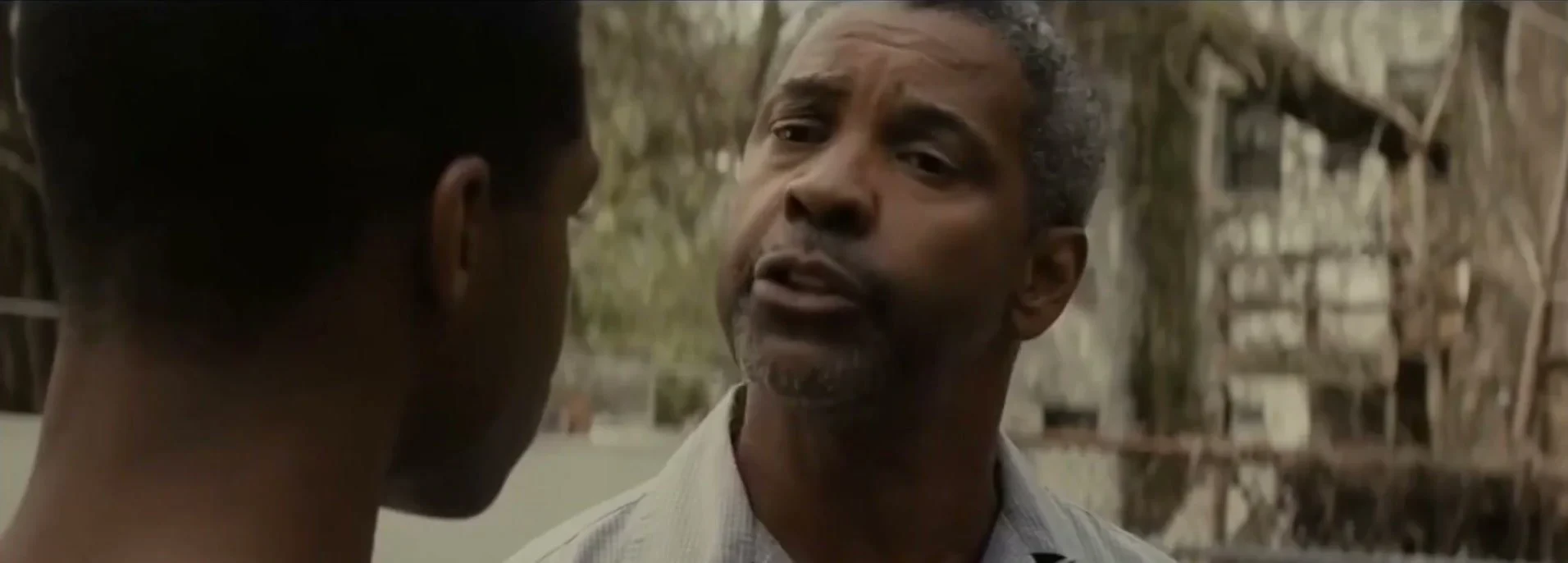
The great irony in all the drama is that AI is finally the technology that puts artists in the driver's seat - it's a tool of freedom, not oppression. No one makes this case better than AI Denzel Washington:
“I've spent the last 10 years chasing creative freedom, sick of wasting my energy on other people's projects just for a paycheck, craving the space to make something truly creative. And guess what? That was never gonna happen in that industry, so I walked away.
And now that I'm having fun... people call it slop just because it's not industry standard. You know what? Fuck industry standards. Every technique I picked up was just about giving myself more ways to express myself. I didn't get into this to meet anyone else's standards.
Everyone's terrified, convinced the studios don't need artists anymore. It's the artist who doesn't need the studio.”
How did it get this way? How did hundreds of thousands of Western developers decide to commit seppuku over a cabal of indie artists, who are a minority even in AAA studios? The answer is two deaths in the family. The leaders who would normally push back are gone, and the artists filled the vacuum.
Two Deaths in the Family
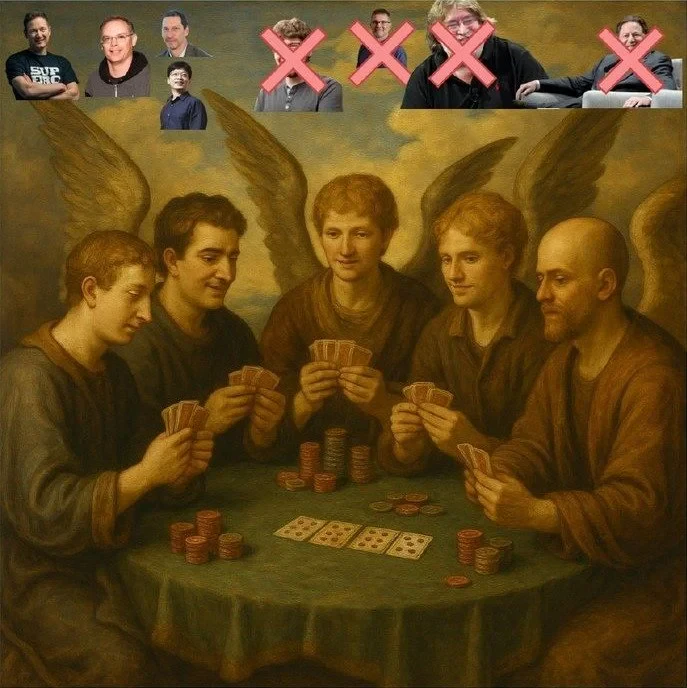
The first death is the founder-CEO. Founders make big, potentially embarrassing bets: Zuckerberg poured billions into Reality Labs, Bezos built AWS and Prime Video out of a bookstore, and Armstrong kept Coinbase mission-focused. Can you imagine Andrew Wilson or Strauss Zelnick doing any of these pivots?[2] Some say Andrew is still knocking on Bob Iger's door, while Zelnick's idea of a pivot is a Peloton over a row machine. At the end of the day, the biggest game companies are run by stewards of capital, and stewards are paid to avoid embarrassment.
Unluckily, our founder-CEOs keep dying. Jason Citron, who founded Discord while trying to build a MOBA, stepped down as CEO in 2025. Mike Morhaime handed Blizzard to a World of Warcraft executive producer in 2018. Riot's founders, Brandon Beck and Marc Merrill, stepped back from running the company in 2017. Unity's David Helgason gave the CEO job to former EA chief John Riccitiello in 2014. Twitch's Emmett Shear stepped down in 2023, CD Projekt's Marcin Iwiński gave up the joint-CEO role in 2022, and Niantic's John Hanke sold Pokémon GO and the rest of the games business to Scopely in 2025. And the founders weren't the only ones to go.
The second death is the engineer-designer.
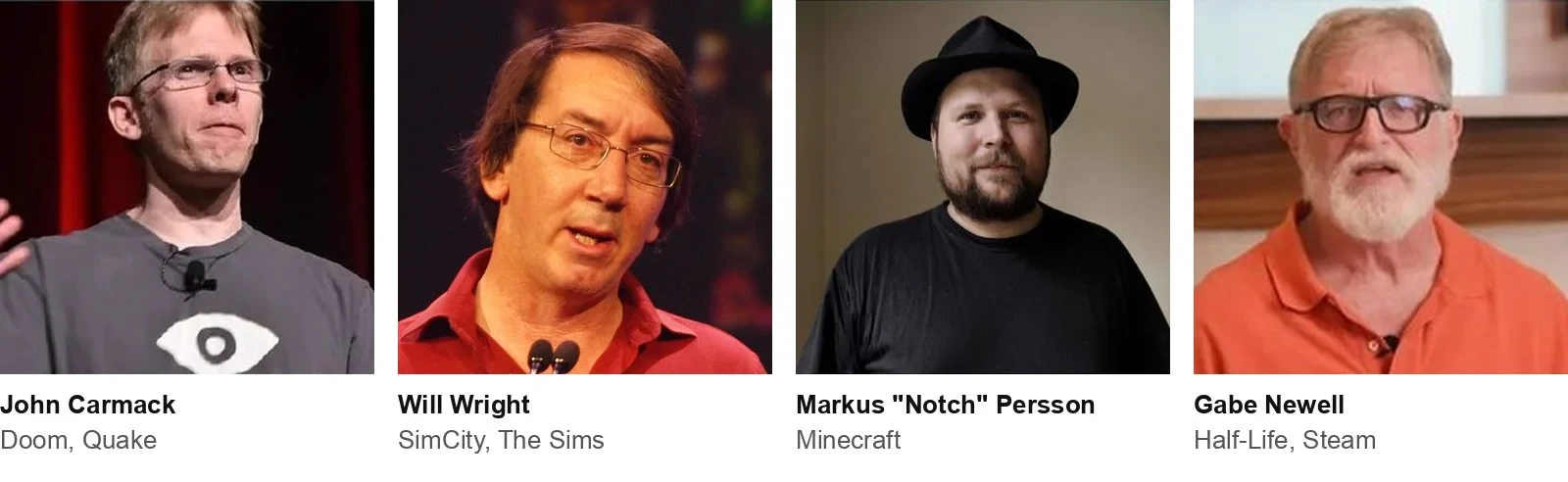
Gaming's first designers were engineers: John Carmack wrote the engine and then the game, Will Wright built simulations and sold them as toys, Markus Persson wrote and designed Minecraft himself, while Gabe Newell spent 13 years at Microsoft as a programmer, leading the port of Doom to Windows 95, before leaving to make Half-Life, then built Steam. The explorers in this industry could build the thing themselves, which meant they could try things nobody had asked for. In the old cliché that games are where art meets science, it's clear that it's the science that takes the lead in video games; the art came later.
The Savior Proves It
So look at who finally broke ranks. On October 23, responding to Steam's AI content disclosures, Epic CEO Tim Sweeney wrote: "Forcing developers to write a political statement to be used against them by the hate mob they're helping organize is abhorrent." In a separate forum, Sweeney said, "AI is happening, AI won't un-happen, and Epic is going all-in to bring the gains to all game developers."
For three years the Western AI fight in games has been about labels, surveys and petitions. Sweeney's posts are a turning point because they move the fight to the one place a guild can't vote on: the engine. A large share of the industry builds on Unreal. When the engine goes AI-first, every studio on it inherits the tool, whatever its art department thinks.
And notice who did it. Sweeney is both deaths, still alive. He programmed ZZT himself in 1991, the engineer-designer. He founded Epic that same year and still runs it 35 years later as the controlling shareholder of a private company, the founder-CEO, with no board of stewards to talk him out of an embarrassing bet. This is the same man who fought Apple's store rules as a personal vendetta, sacrificing Fortnite's mobile ambitions on the altar. The one Western leader willing to go all-in on AI is the last person in Western games who fits both descriptions. If the two deaths weren't why nobody pushed back, the West would have more than one Sweeney.
A Return to the Start

We argue, the East ships. Yet we have it in our power to reverse course, and indeed Sweeney lit a spark that we need only kindle to succeed. Not as a compression of creativity, but AI as the greatest tool of art!
Never before has it been so easy to express yourself in a game without the need for millions in funding or a 50-person dev team. The explorers who started this industry could build the thing themselves, and with AI anyone can again. I speak from experience: my own vibe-coded game will go live in November. I never thought I'd be able to so uniquely and singularly express myself in this way, and I count myself among the few lucky enough to be born in this era - Western developers should too.
The survey skews indie. Of the respondents who work at studios, 45% are at independent studios and 31% at AAA ones, and the report itself says it "had a higher number of workers from indie studios than those from AAA companies." Indies drove that 55%. The most positive groups were executives and business operations, where 19% said generative AI is having a positive impact, against 7% of all respondents. ↩︎
The AI talk depends on the audience. At EA's September 2024 Investor Day, Wilson called generative AI "the very core of our business." By October 2025, EA's employee FAQ was promising a "thoughtful, steady approach to AI," and on stage at iicon in April 2026 Wilson described it as "almost entirely augmentation." ↩︎