6 Things from 6 Days in Shanghai
1. Yes, Chinese game developer wages are rising, and yes, China itself is outsourcing
A $100k annual salary in USD is not unheard of, nor is $1M USD for star employees. Competition for game talent is fierce, which is why the whole Lilith-FunPlus-who-knows-who-else-start-a-game-as-a-company model is emerging. In practice, this is structured at the level of an individual game: employees receive equity-like stakes in a specific project, often with participation in dividends tied directly to that game's performance. Not only does it let employees share in the success, but it's also a retention mechanic.
Of course, rising wages mean a changing comparative advantage: it is simply better to outsource parts of development, with Vietnam playing a key emerging role. All real, as far as I can tell.
2. No, you don't need a VPN to access global Steam
Personally confirmed. Everyone I asked was about as confused as I am. How is it that the CCP is allowing Chinese users to access the global version of Steam without a VPN? I got about three different origin stories or speculations on why this is the case, but nothing lined up.
This bypasses requirements such as having a domestic publishing partner and even brushes up against censorship concerns. It's even more striking when you consider that the CCP takes many board seats on key firms, which should be crying foul for protectionism from foreign distributors. Don't forget this is also the same Politburo that called gaming "opium of the people."
3. Rising video card and RAM prices will hurt China's domestic HD demand faster than they will in the U.S.
Wages may be rising in the game industry, but in China, growth has started to slow, while the United States continues to see far greater real wage gains. 4X may be dominated by Chinese publishers, but it is increasingly dominated by U.S. consumers.
On the margin, AI chip demand will start to affect domestic demand for high-fidelity games. All this suggests is a doubling down on mobile and lower-quality graphics.
4. Chinese firms openly access Western AI models via VPN
The CCP has stepped up packet sniffing, and simple NordVPN or ExpressVPN no longer reliably gets you through the Great Firewall. Despite this, nearly all firms openly use VPNs to access virtually everything, including Western AI models.
While much of the conversation around, say, Anthropic's models has focused on early access being used to penetrate Western security, this is already effectively guaranteed to happen on a lag via VPN access. We'll see the same dynamic in game development. The conversation, particularly on the Patel-Jensen podcast about chip controls, is starting to ask whether AI VPN controls are far more important.
5. Chinese economic policy looks a lot more like Sweden
At a high level, the system resembles a blend of welfare state and industrial policy, and the comparison becomes clearer when you look at how labor and capital are taxed. China's top marginal income tax reaches 45%, while employer-side social contributions typically land somewhere in the mid-teens to mid-twenties depending on the city. Dividend income, by contrast, is often taxed around 20%.
Sweden follows a similar shape, but generally pushes harder. Top marginal income taxes run higher once municipal and national layers are combined, and employer payroll taxes sit just above 31%. Dividend taxation can also land around 20% within certain limits, though the system becomes more punitive outside them. The result is that Sweden likely taxes more, but not by an order of magnitude, and the structure of the system feels surprisingly comparable.
Where the analogy becomes more interesting is in state capacity. Both systems are capable of actually executing on policy. Sweden does it through a rules-based, predictable framework; China does it through a mix of central direction and local discretion. The mechanisms differ, but the outcome is similar: when the state decides to prioritize something, whether it's industrial upgrading or social stability, it tends to happen.
In that sense, China can look like a lower-tax, less uniform version of Sweden, one that trades consistency for flexibility while still maintaining a high degree of coordination between the state and private firms.
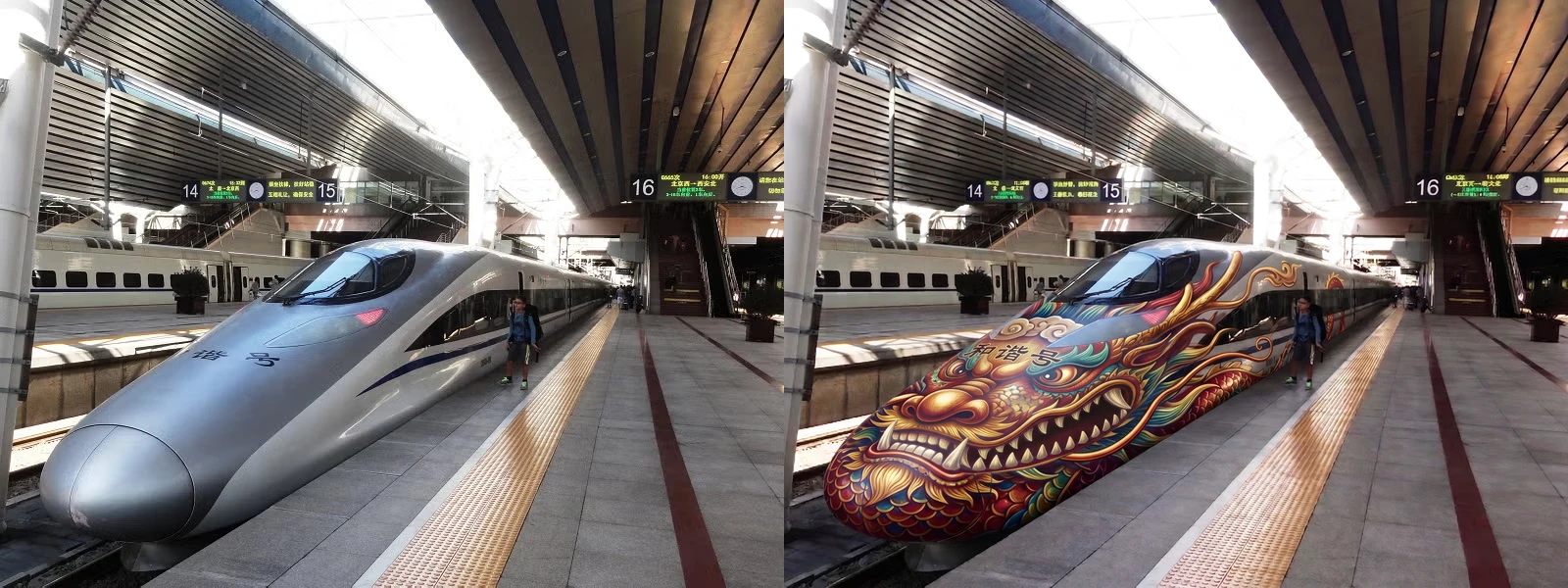
6. The high-speed train should be branded like a dragon
Much has been said about China's rapid expansion of high-speed trains, particularly the Fuxing high-speed trains. Yet they seem to have missed the most obvious win: redesigning the nose of the train so it looks like a dragon. It's a free brand marketing win and a reinforcement of Chinese national identity.